How to Write a Project Brief That Prevents Scope Creep
The most common reason projects go sideways has nothing to do with execution. No one missed a deadline by being careless. The project went wrong because it started wrong, with a brief that covered three or four of the eight dimensions an agency needs and left the rest to assumption.
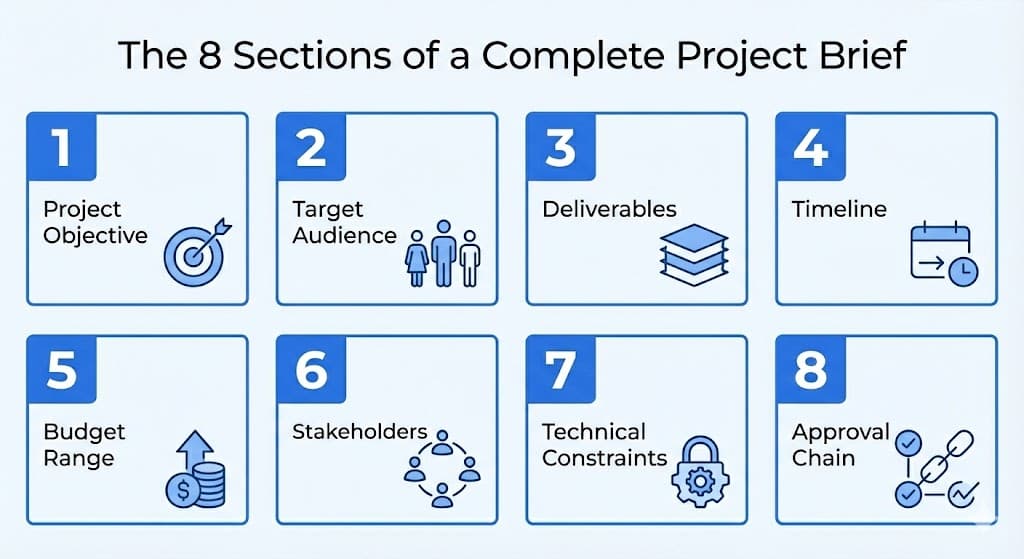
Why most project briefs fail before the project starts
Clients do not withhold information deliberately. They describe the outcome they want without specifying the constraints. They say 'we need a new site' without defining how many pages, what integrations are required, or who has final sign-off on the homepage. The agency hears a scope. The client imagined a different one. By week four, both are defending positions they each believe are reasonable.
A project brief exists to prevent that gap. Not by capturing everything the client said, but by capturing everything both parties need to commit. A brief that does not cover budget, approval chain, and explicit deliverables is not a brief. It is a summary of a conversation, and conversations are remembered differently by everyone who participated.
Research consistently shows that projects with documented, agreed-upon briefs have significantly lower rates of scope change and revision disputes. The brief is not bureaucracy. It is the cheapest risk management tool an agency has.
of business and IT executives admit their software projects are always or usually doomed from the start, driven by fuzzy objectives, misaligned stakeholders, and poor requirements definition.
Source: Geneca, Doomed From the Start? (survey of ~600 executives) →The 8 sections every project brief needs
A project brief that prevents downstream problems covers eight dimensions. Each one maps to a specific failure mode when it is missing:
of unsuccessful projects fail to meet their goals due to poor requirements management, the single leading cause of project failure, ahead of budget and timeline issues.
Source: PMI Pulse of the Profession, Requirements Management (survey of 2,066 project professionals) →- Project objective: What success looks like in measurable terms. Not 'improve brand perception' but 'increase newsletter sign-ups by 20% before product launch.' Without a specific objective, both parties will evaluate the project differently at the end.
- Target audience: Who the deliverables are for. Demographics, behavior, geography, and what they need to believe after interacting with the output. Specific enough that two designers reading it would make similar decisions.
- Deliverables: A named, scoped list of every output, with format, quantity, and platform. Not 'a website' but 'five pages, mobile-optimized, built in Webflow, with a contact form connected to HubSpot.' Every deliverable that is unnamed is a negotiation deferred.
- Timeline: Key milestones with dates, not just a final deadline. When will the client provide content? When is the design review? When does development start? A launch date without intermediate milestones is a deadline, not a timeline.
- Budget range: A defined number or range. If the client is not willing to commit to a range at the brief stage, that is a risk flag to resolve before proceeding, not after. Undefined budgets lead to undefined scope.
- Stakeholders: Who is involved and at what stage. Who reviews? Who approves? Who has final say? The name of the final approver, not just their role, is the single most important piece of information for managing revision cycles.
- Technical constraints: Existing platforms, required integrations, hosting environment, accessibility requirements, and performance targets. Every constraint that is discovered mid-project expands scope.
- Approval chain: How revisions are submitted, how many rounds are included in the scope, and who has the authority to call the project complete. Without a defined approval chain, every revision is a negotiation.
How to write each section well
The sections above are the structure. Writing them well is a separate challenge. Here is what distinguishes a complete section from a placeholder for each:
Objective: outcome over output
Weak: 'Redesign the website to improve the brand.' Strong: 'Redesign the website to increase mobile conversion from 1.2% to 2.0% by Q3.' The difference is measurability. If you cannot describe success as a specific, observable change, the objective is not specific enough.
Deliverables: name everything, exclude explicitly
Weak: 'New website with updated design.' Strong: 'Homepage, about page, three product pages, and a contact page. Desktop and mobile. Built in Webflow. Blog and e-commerce not included.' The exclusion is as important as the deliverable list. If you do not write it down as excluded, it will be assumed as included.
Budget: a range, not a placeholder
Weak: 'Budget TBD / flexible.' Strong: '€35,000–€50,000, inclusive of design and development. Copy and photography out of scope.' A range is better than nothing. TBD is not a budget. It is a signal that the client has not committed, which means scope will expand until the budget becomes a crisis.
Approval chain: a name, not a role
Weak: 'Marketing team will review.' Strong: 'Sarah Chen (Head of Marketing) reviews design. CEO James Hartwell has final approval on homepage. Legal not involved.' The difference between a role and a name is the difference between a revision cycle that ends and one that does not.
| Section | Weak version | Strong version |
|---|---|---|
| Objective | Improve brand perception | Increase mobile conversion from 1.2% to 2.0% by Q3 |
| Deliverables | New website with updated design | 5 pages, mobile-optimized, Webflow, blog excluded |
| Budget | Budget: flexible / TBD | €35,000–€50,000, copy and photography out of scope |
| Approval chain | Marketing team will review | Sarah Chen reviews design. CEO James Hartwell has final approval |
Red flags in a brief that signal future problems
Not every brief gap is obvious. Some of the most damaging ones look fine on the surface. Watch for these four patterns:
'Budget: flexible' or 'Budget: TBD' in a brief means the client has not made a financial commitment. Every conversation about scope from this point will be harder than it needs to be. Resolve it before signing.
A brief that names a project manager as the point of contact but does not name the final approver is hiding a decision-maker. When the revision arrives from 'the CEO who just looked at it,' you are in a revision cycle that was not in the brief.
A brief that says 'website' without specifying page count, platform, or included features is an assumption, not a scope. Everything the client thinks is 'part of a website' is now your problem to manage.
A brief that does not address how scope changes are handled is a contract that has no enforcement mechanism. The first out-of-scope request will test your relationship, and the absence of a defined process will make it more expensive than it should be.
Get a complete brief without starting from scratch
Writing a complete brief from scratch for every project is time-consuming. Most agencies iterate on a template and adapt it to each client. The risk is that the adaptation stage is where gaps appear: fields left blank because they felt premature, and sections skipped because the client seemed trustworthy.
Clariva takes a different approach. Paste an existing brief such as an email thread, a client document, or a PDF. Clariva scores it against all eight coverage dimensions, flags every gap with the specific evidence and a suggested next action, and generates a complete brief pack ready for both parties to commit to.
See a complete project brief template you can use immediately: Creative brief template →
Or see an annotated real-world example: Project brief example →
Paste any brief. Clariva scores it against all 8 dimensions, flags every gap, and generates a brief pack your team can commit to with its brief analysis software.
Analyze your next brief with ClarivaFrequently asked questions
What is a project brief?
A project brief is a document that defines the scope, objectives, deliverables, timeline, budget, stakeholders, and approval process for a project before work begins. It exists to align both the agency and the client on what is being built, who is responsible, and what success looks like, so that both parties are committing to the same outcome.
What should a project brief include?
A complete project brief should cover eight dimensions: project objective, target audience, deliverables, timeline, budget range, stakeholders, technical constraints, and approval chain. Every section that is missing or vague is a risk flag. Gaps in the brief are the primary cause of scope creep and revision disputes.
How is a project brief different from a scope document?
A project brief captures the strategic context of a project: the objective, the audience, the constraints, and the approval structure. A scope document is operational. It lists the specific deliverables, milestones, and change request process that the project will be held to. Both are necessary. The brief informs the scope document, which is what gets signed and enforced.
How long should a project brief be?
A project brief should be as long as it needs to be to leave no ambiguity, and no longer. For most agency projects, a complete brief is one to three pages. Length is not the goal; completeness is. A brief that covers all eight dimensions in one page is better than a vague five-page document.