The Client Discovery Process: How Agencies Capture What They Need Before Starting
Discovery is not a kickoff call. It is not a brief sent by email and accepted without review. It is a structured validation process with a defined entry point, defined outputs, and a defined exit condition: the moment at which both parties can commit to the same scope.
What client discovery actually means
Most agencies do something that resembles discovery: a call to understand the project, a follow-up email, and a brief that gets revised before it is signed. The problem is that this process is unstructured. Different team members run it differently. Different clients provide different levels of detail. There is no consistent standard for what 'complete discovery' looks like.
A structured discovery process has three defined outputs: a complete brief (all eight coverage dimensions present and specific), a risk map (gaps that will cause problems if left unresolved), and an agreed scope (a document both parties can sign). When those three outputs exist, discovery is complete and the project can start. When they do not, discovery is ongoing, whether the agency treats it that way or not.
The distinction matters because most scope creep, budget overruns, and revision disputes do not originate in execution. They originate in a discovery process that ended before it should have: before the budget was confirmed, before the final approver was named, and before the content delivery timeline was committed to.
The cost of skipping structured discovery
When discovery is unstructured, assumptions fill the gaps. Assumptions are not failures of intent. They are the natural result of starting a project with incomplete information. Both the agency and the client make reasonable assumptions based on what they know. The problem is that they make different assumptions, and no one finds out until the first deliverable arrives.
lost annually by US businesses due to poor communication, equivalent to $12,506 per employee per year. The cost is distributed invisibly across clarifying emails, re-explained decisions, and scope disputes that should have been resolved before work started.
Source: Grammarly & Harris Poll, State of Business Communication 2022 →of people say they have personally wasted time as a result of communication issues in their business, and most of this is preventable at the discovery stage.
Source: Project.co, Business Communication Statistics 2026 →of unsuccessful projects fail to meet their goals due to poor requirements management, the single leading cause of project failure, ahead of budget and timeline issues.
Source: PMI Pulse of the Profession, Requirements Management (survey of 2,066 project professionals) →Three patterns appear repeatedly in projects where discovery was skipped or abbreviated:
The agency scoped to what they thought the client wanted. The client budgeted for what they thought the agency would charge. The difference surfaces when the invoice arrives, and the conversation that follows is harder than the one that should have happened during discovery.
The agency set a launch date based on production time. The client agreed to the date without confirming when they could deliver content. Content arrives three weeks late. The launch date moves. The client is frustrated by a delay they contributed to but did not feel accountable for, because the content delivery date was never written down.
The project manager reviewed and approved the design. Then the CEO saw it and asked for significant changes. Neither the agency nor the day-to-day contact had told the CEO the design was in review. The approval chain was never documented, so no one knew who needed to be in the loop.
Each of these is preventable with a structured discovery process. Each of them is very difficult to recover from once the project is underway.
How to run a client discovery process
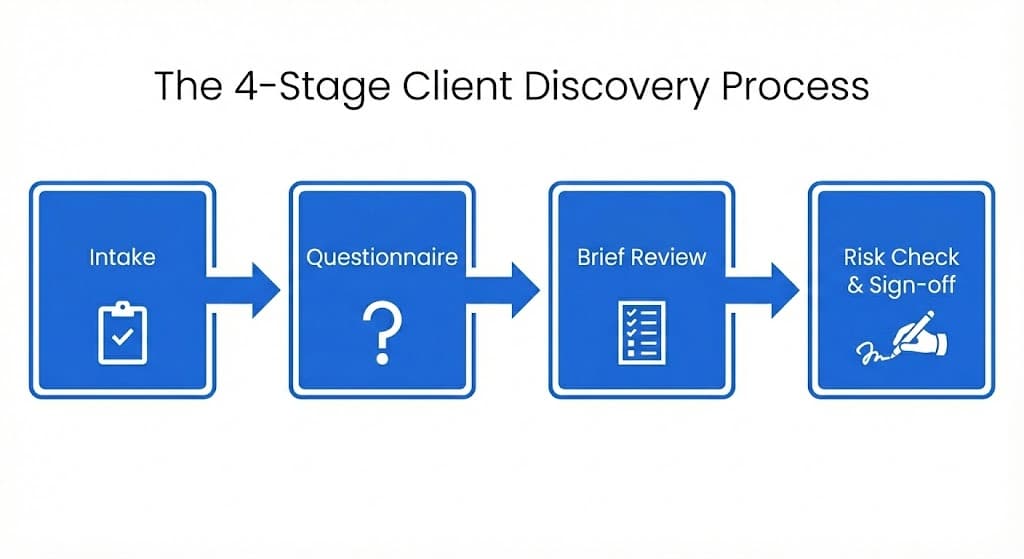
A structured discovery process has four stages. Each stage has a specific output:
Stage 1: Intake
Send a client intake form before the first call. The intake captures the minimum information needed to validate the project: budget range, timeline, deliverables, stakeholders, and technical constraints. The goal is not to understand the project fully. It is to confirm that the project is viable before investing time in a kickoff call.
If the intake comes back with a blank budget field or an undefined approval chain, those gaps become the first agenda items on the kickoff call, not discoveries made three weeks in.
Stage 2: Questionnaire
After the intake confirms viability, a client questionnaire goes deeper. This is where you collect brand context, past agency experience, competitive landscape, and the nuances that shape how the work should be approached. A questionnaire is sent after the intake is complete, not before, so you are not asking understanding questions before you have confirmed the project is scoped.
Stage 3: Brief review
With intake and questionnaire complete, you have enough to write a project brief. Review it against a completeness standard: are all eight coverage dimensions present and specific? Is the budget a range or a number, not TBD? Is the final approver a name, not a role? Every gap at this stage is a risk flag to resolve before commitment.
Stage 4: Risk check and sign-off
Before the project starts, run a risk check. Every gap in the brief, every assumption, every constraint that has not been confirmed is a potential scope creep vector. Document them. Resolve the high-severity ones. Get sign-off from both parties on the brief as written. That sign-off is what makes the scope enforceable.
Real examples of discovery gaps
Three anonymized examples from agency engagements where discovery gaps caused downstream problems:
Example 1: The moving launch date
A digital agency agreed to a website launch in ten weeks. The brief included a launch date but no content delivery milestone. The client delivered content in week seven, instead of week three as the agency had assumed. The launch moved to week thirteen. The client was frustrated. The agency had lost three weeks of billable time to waiting. The fix was a single line in the brief: 'Content delivery by [date]. Delays to content delivery will affect the project timeline.'
Example 2: The invisible stakeholder
A brand studio completed three rounds of design, approved by the Head of Marketing. At the final presentation, the CEO asked for the brand direction to be reconsidered. Neither the studio nor the Head of Marketing had included the CEO in the review process, because no one had documented that the CEO's approval was required. The approval chain in the brief said 'Marketing team.' The studio reworked two weeks of design. The fix was naming the final approver explicitly and confirming their involvement at each milestone.
Example 3: The budget that was never a range
A development agency built an e-commerce site for a client whose stated budget was 'in the €40–50k range.' Midway through the build, the client asked to add a custom product configurator. The agency quoted an additional €15,000. The client expected it was included in the scope. Neither party had documented what the €40–50k range covered explicitly, or what it excluded. The additional feature became a negotiation that damaged the relationship.
Start your next project with complete discovery
A structured discovery process is the highest-leverage change an agency can make to reduce scope creep, client disputes, and unprofitable projects. It costs time upfront, typically two to four hours per project, and saves multiples of that when problems are caught before they become crises.
Clariva automates the structured parts of discovery: generating a tailored intake from a project description, scoring the completed brief across all relevant dimensions, and surfacing every gap with the specific evidence and a suggested next action. You resolve the gaps. Clariva validates the result. When the brief is complete, the project is ready to start.
Download a free client intake form to start your discovery process: Client intake form template →
See the full client questionnaire for deeper discovery: Client questionnaire →
Paste any brief. Clariva scores completeness, flags every gap, and generates a brief pack ready for both parties to commit to.
Analyze your next brief. Clariva runs the discovery process automaticallyFrequently asked questions
What is client discovery in an agency context?
Client discovery is the structured process an agency uses to validate a project before committing to it. It produces three outputs: a complete brief with all coverage dimensions present and specific, a risk map identifying gaps that could cause problems, and an agreed scope that both parties sign. Discovery is complete when those three outputs exist, not when a kickoff call has taken place.
What is the difference between client discovery and a kickoff call?
A kickoff call is a meeting. Client discovery is a process. Discovery happens before the kickoff. It is where you collect the intake form, run the questionnaire, review the brief for completeness, and get sign-off on the scope. When discovery is done correctly, the kickoff call becomes a confirmation of what both parties already agreed to in writing, not a session where you are still gathering basic information.
How long should client discovery take?
For most agency projects, structured discovery takes two to four hours of elapsed time across the intake, questionnaire, brief review, and sign-off stages. The investment prevents ten to twenty hours of scope dispute and revision management that unstructured projects typically require. Discovery time is proportional to project size, and larger, more complex projects warrant more thorough discovery.
What should client discovery produce?
Client discovery should produce a complete project brief, a risk log of unresolved gaps, and a signed scope document. These three outputs are the entry condition for starting work. When they exist, the project manager has a documented foundation. When they do not, the PM tool is tracking from an incomplete brief, and the gaps will surface as disputes during execution.