Agile Project Scope Document Template (Free Template)
Agile projects still need scope boundaries. This template helps agencies define sprint-level commitments, decision triggers, and change-control rules without forcing waterfall-style rigidity.
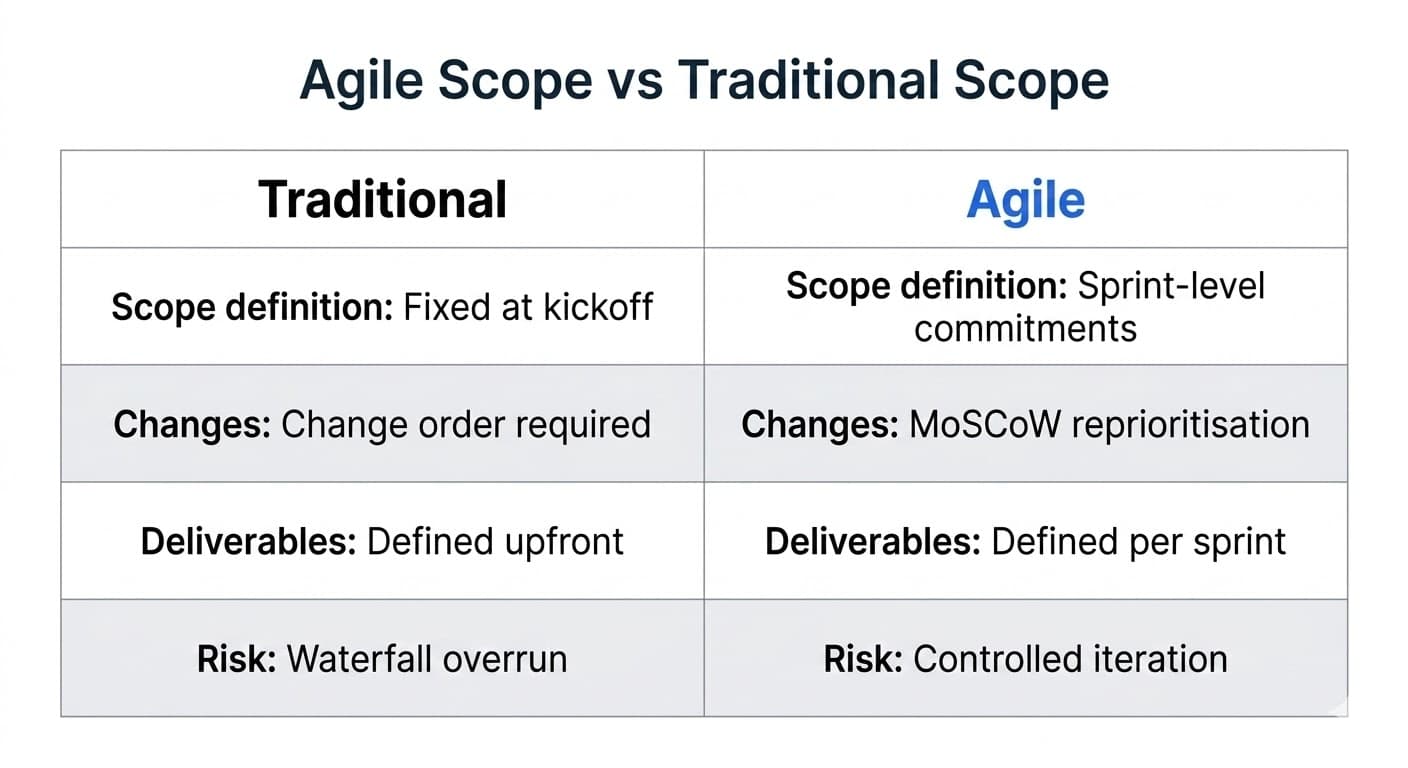
How agile scope differs from traditional scope
Agile scope is adaptive, but not undefined. Teams can reprioritize backlog items while still protecting delivery economics through explicit sprint goals and change rules.
The objective is to create controlled flexibility: fast iteration inside agreed boundaries.
Core agile scope sections
- Sprint outcome: Define what each sprint must deliver in observable terms.
- MoSCoW priorities: Classify backlog items as must, should, could, and won't.
- Change trigger rules: Define when backlog changes require commercial review.
- Acceptance criteria: Set quality and completion conditions for each priority item.
Agile scope template block
# Agile Project Scope Document

## Sprint Objective
[Observable sprint outcome]

## Prioritized Scope (MoSCoW)
Must: [items]
Should: [items]
Could: [items]
Won't (this release): [items]

## Change Control
Trigger: [what qualifies as scope change]
Impact review: [time/cost/dependency]
Approval path: [roles and turnaround]

## Acceptance Criteria
[Definition of done for sprint deliverables]
Example sprint-level scope baseline
A practical agile project scope document template should show what is fixed for the sprint and what can move. The baseline below helps teams protect commitments without blocking reprioritization.
- ☐Sprint objective written in observable terms
- ☐Must-have backlog items tied to objective
- ☐Known technical constraints documented
- ☐Approval path for net-new requests defined
- ☐Daily review for scope-impacting requests
- ☐Impact notes for any backlog re-prioritization
- ☐Commercial review for effort increase above threshold
- ☐Updated sprint plan shared with stakeholders
Common agile scope mistakes
A backlog is a priority queue, not a commitment list. Without sprint boundaries, teams absorb extra work silently.
Teams accept change as 'agile' even when effort grows materially. Define when change requires cost/timeline review.
If completion criteria are unclear, stories look done at review but reopen in delivery, causing hidden overruns.
How to implement this agile project scope document template
Use the template at sprint planning, not after work starts. Scope controls are most valuable when they influence what the team commits to before execution.
Keep the document short and update at each sprint boundary. In agile delivery, scope governance is iterative, but it still needs explicit commercial checkpoints.
- ☐Confirm sprint objective and must-have items
- ☐Validate acceptance criteria for each must-have
- ☐Define change triggers and approval path
- ☐Share baseline with client before sprint starts
When to use agile scope vs fixed-price scope documents
- Use agile scope when priorities can change between sprints but commercial controls must remain explicit.
- Use fixed-price scope when deliverables and timeline must be fully committed before execution.
- If contract is fixed but delivery is sprint-based, use agile scope for planning and fixed scope for commercial boundary.
Decision thresholds for agile change control
Frequently asked questions
Can I use a scope document in agile delivery?
Yes. It defines boundaries and change rules while allowing controlled reprioritization.
What should agile scope include?
Sprint outcomes, priorities, acceptance criteria, and change-control triggers.
How is agile scope different from waterfall scope?
Agile scope is iterative by sprint, but still commercially governed.
Skip the template. Generate it automatically.
Clariva generates this document from a brief description or existing document, scored, validated, and ready to use.