Scope creep vs change request for agencies
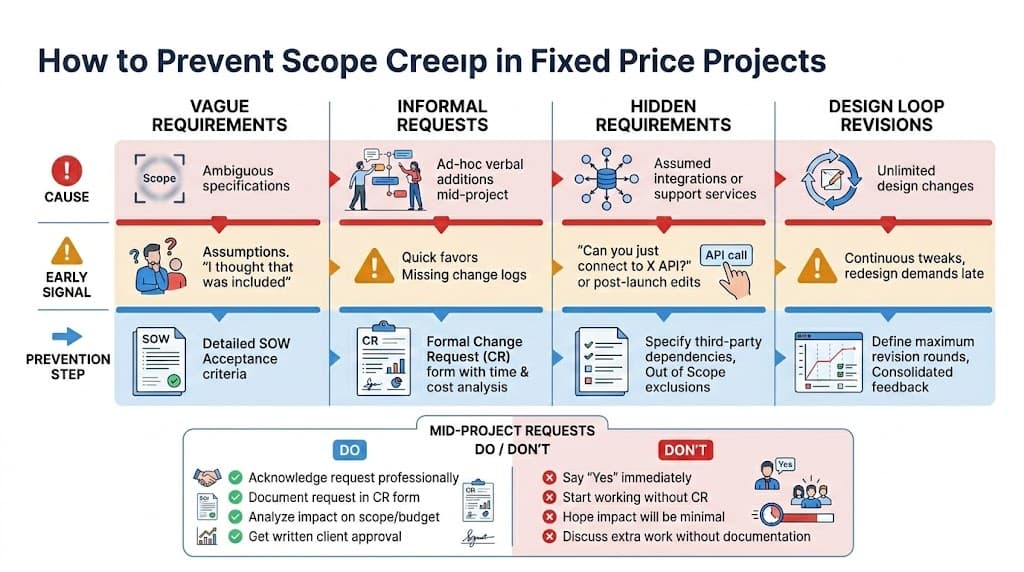
Most agency teams confuse these two in live delivery. Scope creep feels like a process problem, but it is usually a classification problem. If work expands without explicit approval, you are in scope creep. If work expands with documented cost and timeline impact, you are in change control.
What scope creep looks like in agency delivery
Scope creep starts when extra work is accepted before it is classified. A request arrives in Slack or on a call, the team says yes to keep momentum, and the project keeps moving with no updated scope baseline. The work is real, but the commercial terms are not.
In practice, this usually shows up as silent additions: extra pages, additional revision rounds, or new integration tasks that were never priced. Teams still deliver, which keeps the relationship smooth in the short term, but the project margin absorbs the difference.
What a change request is, operationally
A change request is not conflict. It is the formal mechanism that lets both parties add work without ambiguity. It requires four parts: written request, impact analysis, pricing, and explicit approval before execution.
| Decision point | Scope creep | Change request |
|---|---|---|
| Approval | Implicit or none | Explicit and written |
| Pricing | Unpriced or delayed | Quoted before work starts |
| Timeline impact | Hidden | Declared upfront |
| Commercial outcome | Margin erosion | Controlled expansion |
A simple agency decision rule
- Does this request add net-new effort or deliverables?
- Does it change timeline, dependencies, or approval path?
- Was it explicitly included in signed scope language?
If the answer to the first two is yes, and the third is no, treat it as a change request every time. This keeps team behavior consistent and avoids ad hoc exceptions under deadline pressure.
How scope creep shows up in real projects
Scope creep rarely announces itself. It accumulates through small decisions that feel reasonable in isolation. Three patterns account for most of the margin erosion agencies experience.
The “quick addition” pattern
A web agency scopes a five-page site redesign. During development, the client asks for a sixth page: a careers page. It takes half a day, the team builds it, and no one logs a change request. Two weeks later, the client asks for a seventh page, then a custom form, then an integration with their ATS. Each request was small. The total added three unpriced days to the project and cut the margin from 22% to 9%.
The revision spiral
A branding agency delivers a first-round logo concept. The marketing director gives feedback. The agency revises. Then the VP of product sees it and has different notes. Then the CEO weighs in. The brief listed “two revision rounds,” but the brief did not name who has final approval. The agency is now on round five, and no one authorized the additional work because no one was explicitly authorized to stop it.
The assumption gap
A digital agency prices a Shopify build. The client says “we need product pages.” The agency scopes 20 static product pages. The client expects a full e-commerce catalog with filtering, search, and dynamic inventory sync. Both sides believed they were describing the same thing. The scope document listed “product pages” without specifying count, functionality, or integration requirements.
When to absorb the work vs. when to charge
Not every out-of-scope request should trigger a change request. Some requests are small, the relationship is strategic, or the effort is genuinely trivial. The decision to absorb or charge should be deliberate and tracked, not automatic or emotional.
| Situation | Absorb | Charge |
|---|---|---|
| Effort under 30 minutes, one-time | Absorb and log | |
| Effort under 30 minutes, recurring pattern | Charge from the second occurrence | |
| New deliverable or page not in scope | Always charge | |
| Timeline shift requested by client | Charge if it displaces other work | |
| Strategic account, renewal at stake | Absorb, log, and reference at renewal |
The key discipline is logging every absorbed request. When unpriced additions are invisible, the agency cannot quantify the cost of goodwill. When they are tracked, the agency can reference them in renewal conversations and make informed decisions about where to draw the line.
How to issue a change request without damaging the relationship
The conversation does not need to be adversarial. Most clients respond well to change requests when the agency frames them clearly: acknowledge the request, reference the agreed scope, and offer a specific path forward with cost and timeline.
- Acknowledge the request. Confirm that you understand what the client needs and why it matters to them.
- Reference the scope. Point to the specific section of the signed scope document that defines the current boundary.
- Offer the path. Provide a written change request with the estimated cost, timeline impact, and approval step.
Example: “We can add the careers page. Based on the current scope, this would be a new deliverable. Here is the estimate: 1.5 days of design and development at our day rate, which shifts the QA window by two days. If you approve, we can start Thursday.”
Change request template
Use this template for any request that falls outside signed scope. Send it before starting the additional work, not after.
Building a scope classification habit
The difference between agencies that manage scope well and those that do not is rarely about contracts or templates. It is about team behavior. When every project manager classifies incoming requests the same way, scope management becomes an operating system instead of a personality trait.
Train your team to ask three questions before saying yes to any mid-project request:
- Is this in the signed scope document?
- Does it add effort, shift a milestone, or create a new dependency?
- Has it been priced and approved in writing?
If the answer to the first question is no and either of the other two is yes, it is a change request. No exceptions, no judgment calls, no “just this once.” The consistency is what protects the margin.
Related resources
FAQ
What is the difference between scope creep and a change request?
Scope creep is unapproved expansion that gets absorbed informally. A change request is formal, priced, and approved before work starts.
When should agencies issue a change request?
Issue a change request whenever a request alters deliverables, timeline, dependencies, or effort beyond what was signed.
Can agencies prevent scope creep without hurting client relationships?
Yes. Acknowledge the outcome the client wants, reference signed scope, and offer a clear change-request path with cost and timeline impact.
Should small out-of-scope requests always be billed?
You can allow strategic exceptions, but track them. Repeated unpriced exceptions become hidden margin loss.
Validate scope before you commit.
Clariva flags missing scope terms and helps you prevent scope creep before project kickoff.