How to prevent scope creep in fixed price projects
Fixed price projects fail quietly before they fail visibly. They fail when teams commit to ambiguous scope, accept unclear dependencies, and keep delivering while key assumptions drift. By the time the budget problem appears, the team has already absorbed unpriced work. This playbook is built for agencies that want margin protection without damaging client trust.
of agencies cite scope creep as a top reason for margin decline.
Source: SoDA & Productive — Talent, Culture & Operations Study (2022) →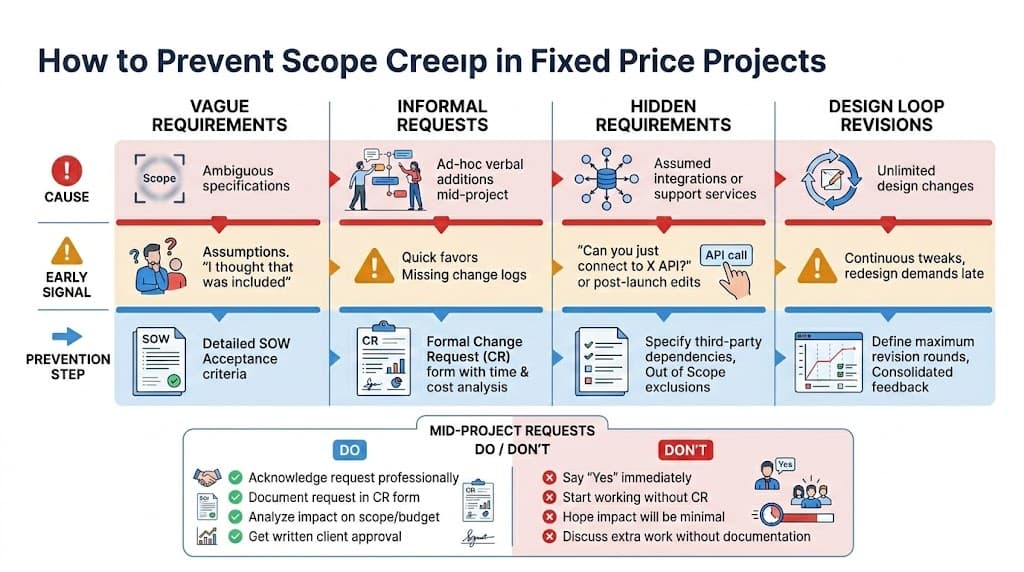
Why fixed-price scope creep happens
Fixed price projects force precision. If scope is vague, every missing definition becomes agency risk. This is why teams feel delivery pressure early: they are trying to execute while still defining what was sold. In time-and-materials work, ambiguity can be priced progressively. In fixed-fee work, ambiguity is usually paid for with margin.
The market context makes this harder, not easier. Agency benchmarks show frequent over-budget outcomes and overservicing behavior in active delivery portfolios (Teamwork.com State of Agency Operations 2023). Meanwhile, average margin baselines remain structurally tight (Promethean Research Digital Agency Industry Report), reducing tolerance for unpriced extra work.
Average agency net margin in 2024 — leaving almost no buffer for unpriced scope work.
Source: Promethean Research — Digital Agency Industry Report (2025) →Professional services benchmarks also show project overrun patterns rising in many organizations (SPI Professional Services Maturity Benchmark 2025), which means fixed-fee agencies need stronger pre-commitment controls, not stronger optimism.
Practical framework: prevention before kickoff and control during delivery
Preventing scope creep in fixed price work is a two-layer system: a scope baseline before kickoff and a controlled change mechanism during delivery. If either layer is weak, profit protection becomes reactive.
Layer 1: Pre-commitment scope baseline
- Deliverables and exclusions: Name every output and list explicit non-included items.
- Dependency ownership: Assign owner and due date for client content, access, approvals, and assets.
- Approval architecture: Name reviewer roles and final approver by person, not function.
- Revision policy: Define included rounds and what triggers extra revision pricing.
- Change rules: Require written request, impact analysis, and sign-off before execution.
Layer 2: In-delivery change control
- Classify immediately: Every request is in-scope revision or scope change. No third category.
- Document impact: Attach cost, timeline, and dependency impact before response commitment.
- Keep one source of truth: Update scope version and milestone plan after each approved change.
- Escalate by severity: High-impact changes require executive approvers, not only project contacts.
This structure aligns with standard agreement models where additional services require authorization and become a formally priced extension rather than informal goodwill work (AIGA Standard Form of Agreement for Design Services).
| Situation | What to do | What not to do |
|---|---|---|
| Client asks for new feature mid-sprint | Classify as change request, quote impact, request sign-off | Start work to keep momentum before approval |
| New stakeholder challenges approved direction | Reference approval chain and log a rework change request | Treat as normal feedback without re-baselining |
| Client content arrives late | Apply dependency clause and re-sequence timeline | Absorb delay internally and compress QA window |
| Team spots unclear requirement | Pause impacted task, clarify in writing, update baseline | Assume intent and proceed to avoid client friction |
Common failure patterns in fixed-fee delivery
The same failure modes appear repeatedly across agency teams. They are usually process issues, not skill issues. Teams know what good control looks like; they just do not apply it consistently when deadlines and client pressure intensify.
- Scope language is broad while pricing is precise. That mismatch guarantees later conflict.
- Approval power is assumed, not documented. Hidden approvers create expensive rework loops.
- Change discussions happen in chat, not records. This breaks auditability and billing confidence.
- Dependency delays are treated as team flexibility. Repeated flexibility becomes unpaid labor.
- Commercial escalation happens too late. Work is often accepted before impact is priced.
- Leads optimize for short-term harmony. Avoiding one difficult scope call can create months of margin erosion.
Prevention is not about being rigid with clients. It is about creating a predictable decision framework so requests can be accepted quickly and fairly when they are valuable, and declined or repriced when they alter the underlying deal.
How Clariva fits
Clariva helps agencies strengthen the first layer, pre-commitment clarity, by scoring brief completeness and flagging missing scope inputs before kickoff. That reduces the number of ambiguous requests later and gives teams better evidence when classifying in-delivery changes.
Then use the extension stack during delivery: out-of-scope response scripts, revision pricing rules, website change request forms, and web design scope templates.
12-week operating cadence for fixed-price control
Many agencies have a strong kickoff and a strong close, but weak middle cadence. Scope creep often enters in weeks 3-8, when delivery is active and teams are optimizing for speed. Use this cadence to keep scope control continuous, not event-based.
Weeks 1-2: baseline lock
Confirm deliverables, exclusions, dependency owners, and approval chain in one signed baseline. Run a kickoff where scope terms are reviewed explicitly, not implied through timeline slides. Record open assumptions and assign owners for closure dates.
Weeks 3-6: change detection
Run a weekly 20-minute scope check: compare active tasks against baseline scope. Flag anything that looks like new capability, added stakeholder requirement, or unplanned dependency work. Classify immediately. Do not wait for end-of-month commercial review.
Weeks 7-10: re-baseline discipline
Approved changes should create a new baseline version with date and approvers. Reject the habit of keeping change decisions in chat threads while scope documents remain static. If baseline and delivery reality diverge, future conflict is predictable.
Weeks 11-12: closure and learning
Before final delivery, run a closeout review: count changes requested, changes approved, unpriced extras, and dependency delays. This gives your team the data to improve future scoping and pricing decisions. Without this loop, every project starts from anecdote instead of evidence.
Scenario walkthroughs
Scenario 1: Client keeps adding work each week
Pattern: small additions enter through weekly calls and are accepted to keep momentum. By week six, team workload has expanded significantly with no scope reset. Response: aggregate all additions into one change summary, classify each item, and present packaged options. Option A keeps baseline and defers additions. Option B approves additions with combined pricing and timeline shift. Option C swaps low-priority scope for new items at neutral budget. This reframes recurring micro-negotiation into one clear commercial decision.
Scenario 2: New executive enters late with major feedback
Pattern: design milestone was approved by day-to-day contact; late executive feedback reopens direction. Response: reference approval chain from baseline, classify requested rework as change, and provide explicit rework estimate. If client wants to avoid cost increase, offer directional trim options within current scope. The key is to separate preference change from quality defect. Preference changes are legitimate, but they are not free in fixed-price production.
Scenario 3: Dependency delays threaten launch
Pattern: client content and approvals arrive late; team compresses QA to preserve launch date. Response: enforce dependency clause early, issue revised milestone map, and make launch-risk tradeoffs explicit. If client wants original launch date, document reduced scope or increased rush cost. Silent compression may look helpful short-term but usually increases defect risk and post-launch rework.
These scenarios are common across fixed-fee agency delivery. The control principle is the same each time: classify, document, decide, then execute. Skipping the decision step is where margin loss starts.
Team operating standards
- One classification owner per project: avoids contradictory decisions from multiple leads.
- 24-hour change impact SLA: speed reduces pressure to start unapproved work.
- Weekly scope review ritual: catches drift before it becomes normal behavior.
- Mandatory baseline versioning: every approved change updates scope version and timeline.
- Monthly leakage review: quantify unpriced work and feed pricing/scoping adjustments.
When these standards are consistent, teams spend less time defending boundaries and more time delivering. The client experience also improves because decisions are faster and tradeoffs are explicit.
Self-audit before kickoff and at midpoint
Run this audit twice: once before kickoff and once at project midpoint. The midpoint pass is critical because scope drift often accumulates gradually and feels harmless until it becomes material.
- Deliverable clarity: can every active task map to a named scoped output?
- Dependency status: are client-owned inputs delivered against date commitments?
- Approval integrity: are decisions coming from named approvers in the agreed chain?
- Revision boundary: are requests still refinements or now introducing net-new work?
- Commercial integrity: were all scope changes priced and approved before execution?
Any failed item should trigger one immediate action: classify and resolve before additional production work. Teams sometimes postpone resolution to protect momentum, but unresolved ambiguity usually slows delivery later with higher rework cost. Early friction is usually cheaper than late correction.
Over time, this audit becomes a quality system for fixed-fee delivery. It gives project leads a concrete way to defend margins while staying collaborative and transparent with clients.
If your team runs this rhythm for three projects in a row, you will usually see clearer estimation, faster client decisions on changes, and fewer late-stage surprises in launch windows.
Executive summary for agency owners
If you only implement three controls, implement these: explicit exclusions in every scope, written change approval before net-new work, and weekly scope drift reviews. These three controls typically prevent most fixed-fee margin leakage without adding heavy process overhead.
The strategic point is simple: fixed-price profitability is a governance problem before it is a delivery-speed problem. Faster execution helps, but it does not compensate for uncontrolled scope expansion. Teams that win at fixed-fee work are usually not the teams that say no most often. They are the teams that classify requests clearly and move decisions quickly with transparent tradeoffs.
Build this into leadership reviews. Ask each project lead the same question every week: what changed, what was approved, and what remains ambiguous. If ambiguity remains open for more than one cycle, escalate immediately.
Prevent overruns at the source. See which scope inputs are missing from your brief before the next project kickoff.
Analyze your briefFrequently asked questions
What is the biggest cause of scope creep in fixed price projects?
Ambiguous scope at commitment, especially unclear deliverables, unnamed approvers, and no written change process.
How do you stop a client from continuously adding work?
Acknowledge requests, classify them against signed scope, and route net-new work through priced change requests before execution.
Can fixed-price projects still be profitable with many change requests?
Yes, if changes are documented, priced, and approved as separate scope increments. Profitability drops when changes are absorbed informally.
What should be in a fixed-price scope baseline?
Include named deliverables, exclusions, assumptions, milestones, responsibilities, revision limits, and change request rules with approvals.
Should agencies pause delivery when scope is unclear?
For unresolved high-impact changes, yes. Continuing without classification usually increases rework and commercial risk.