Digital Agency Profitability: Benchmarks, Margin, and Where Revenue Leaks
The average digital agency operates on a 15% net margin. That number has held steady for a decade. It means a single scope overrun on a mid-size project can eliminate the profit from three others. Yet 67% of agency projects still come in over budget, and 57% of agencies lose $1,000 to $5,000 every month to unbilled out-of-scope work they never invoice. Understanding where the margin goes is the operational question every agency owner needs to answer before they can protect it.
The 15% reality and what it means for overruns
On a EUR100,000 project, a 15% margin leaves EUR15,000. If the project runs 15% over scope, a conservative estimate for a project with undefined deliverables, those additional hours cost more than the entire margin. The client paid the same price. The agency worked more. The profit from that project ceased to exist.
This is the economic context every agency decision operates within. It is why brief quality is a financial question, not just a process one. A brief with undefined deliverables does not just create client friction, it directly erodes margin. A project with an unnamed final approver does not just create revision cycles, it creates unbilled hours that come directly off the bottom line.
The agencies that treat discovery as an operational discipline, with a completeness standard, required fields, and a review step before commitment, are not being bureaucratic. They are protecting their margin before a single hour is billed.
Where revenue leaks
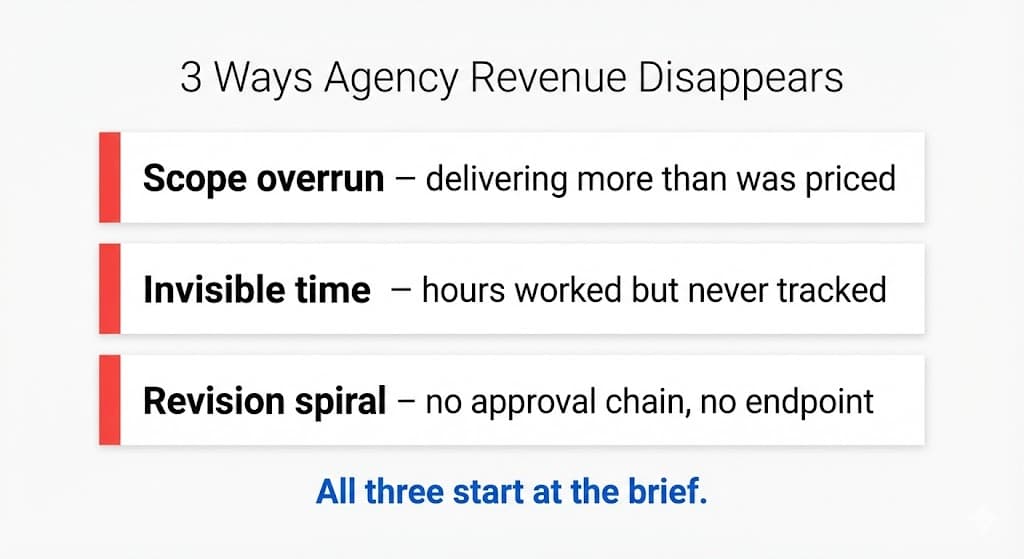
Revenue leakage in agencies comes from two sources that compound each other: scope overrun and invisible time. Both trace back to the same root cause, projects that started before the brief was complete. 78% of US agencies say they rarely or only sometimes charge for out-of-scope work, meaning most of the leakage goes uninvoiced.
Scope overrun happens when the agency delivers more than was priced. Either the brief was vague and the client assumed more was included, or the agency accommodated out-of-scope requests without invoicing them. Both are preventable with a specific brief and a written change request process.
Invisible time is the hours worked but never tracked: revision rounds handled over email, calls that go unbilled, and small additions that feel too minor to invoice. At 15% margin, invisible time accumulates fast. Agencies that track billable time rigorously and have a clear scope document to track against capture significantly more of the revenue they generate.
When the approval chain is undefined, revisions do not have a natural endpoint. Each round goes to a new stakeholder. The agency does more work. None of it was priced. The brief is the only mechanism that makes revision rounds countable and enforceable. Without one, every revision is a negotiation.
What the top-performing agencies do differently
The agencies that consistently protect their margin share a common characteristic: they do not start projects until the brief is complete. They have a standard for what complete means, and they hold to it before committing hours.
of US agencies say they rarely or only sometimes charge for out-of-scope work, leaving the majority of scope overrun uninvoiced and unrecovered.
Source: Ignition, 2025 Agency Pricing & Cash Flow Report →The pattern is consistent: agencies that treat discovery as an operational discipline with a standard intake form, a completeness review, and a sign-off threshold move through pre-commitment faster and with more consistency. The process becomes repeatable. Repeatable inputs produce predictable outputs, and predictable outputs protect margin.
average revenue per full-time employee at digital agencies in 2023, trending upward as AI tools improve production efficiency.
Source: Promethean Research, 2024 Digital Agency Industry Report →Auditing your discovery process for margin risk
The most direct way to improve agency margin is to audit the discovery stage of your last five to ten projects. For each project that ran over scope, identify when the overrun condition was introduced. Focus on when it entered the project, not when it surfaced. In most cases, it was present at the brief.
The questions to ask: Was the budget committed before the project started? Were deliverables named with explicit exclusions? Was the final approver named by person, not by role? Was the content delivery timeline documented and agreed to? Was a change request process in the scope document?
Each no is a margin risk that was present from the start. Each yes is a constraint that protected the project. The pattern across your project history will tell you exactly where your discovery process is leaving margin on the table.
Download the creative brief template to use as your completeness standard →Related resources
Frequently asked questions
What is a good profit margin for a digital agency?
The industry average is 15% net margin. Agencies that run structured discovery and enforce scope sign-off before commitment typically operate above 20%.
Where does agency revenue leak?
The two primary sources are scope overrun (delivering more than was priced) and invisible time (hours worked but never tracked or billed). Both trace back to incomplete project briefs.
How do agencies prevent scope creep from eroding margin?
Define deliverables with explicit exclusions, name the final approver by person, commit a budget range before kickoff, and include a written change request process in every scope document.
What is a brief completeness standard?
A checklist of dimensions that must be present and specific before an agency commits hours: objectives, audience, deliverables, timeline, budget, stakeholders, technical constraints, and approval chain.
Score your next brief before you commit to it.
Clariva flags every gap that creates scope risk before a single hour is billed.