Agency Profit Margin: The 15% Reality and Where the Money Goes
Most agency pricing conversations start with the wrong question. The question is not 'what should we charge?' It is 'what does it cost us when a project runs over?' At a 15% average net margin, a single scope overrun on a mid-size project can eliminate the profit from three others. 67% of agency projects come in over budget. 57% of agencies lose $1,000–$5,000 every month to work they never bill. Understanding where the margin goes is the operational question every agency owner needs to answer before they can protect it.
The 15% reality
Digital agencies have operated on approximately 15% average net margin since 2015. That figure has remained remarkably stable through market cycles, agency consolidation, and the rise of in-house creative teams. It is the baseline that most agencies are working from, and it is thin.
average digital agency net margin since 2015, leaving almost no financial buffer when projects overrun their scope.
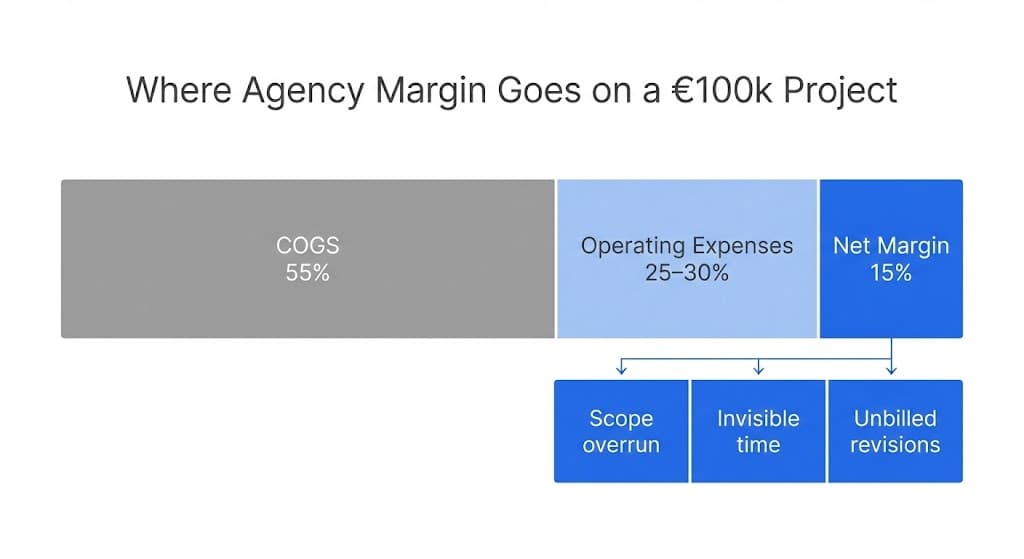
Source: Promethean Research, 2024 Digital Agency Industry Report →What 15% means in practice: on a €100,000 project, the agency keeps €15,000. If the project runs 20% over scope, a common outcome on projects with undefined deliverables, the agency nets nothing, or goes negative. The client paid the same price. The agency delivered more work. The margin disappeared into unbilled hours and revision cycles that were never in the brief.
The math is not forgiving at 15%. A small number of scope overruns per year can transform a profitable agency into one that is growing its revenue while shrinking its profitability, which is the most common failure mode in the industry. Revenue up, margin down, team burning out.
Where the margin goes
Across hundreds of agencies, two categories account for most of the margin erosion. They are not billing errors or underpricing. They are scope overrun and invisible time, and both trace back to the same root cause: projects that started without a complete brief.
of US agencies lose $1,000–$5,000 every month to unbilled out-of-scope work. A further 30% lose more than $5,000 per month. Only 1% of agencies successfully bill for all out-of-scope work.
Source: Ignition, 2025 Agency Pricing & Cash Flow Report (survey of 273 US agency leaders) →of US agencies say they rarely or only sometimes charge for out-of-scope work, meaning most of the overrun goes uninvoiced.
Source: Ignition, 2025 Agency Pricing & Cash Flow Report →Scope overrun
Scope overrun happens when the agency delivers more than was priced, either because the brief was vague and the client assumed more was included, or because the agency accommodated out-of-scope requests without invoicing them. Both causes are preventable. The first requires a more specific brief. The second requires a written change request process. Both require the brief to be complete before the project starts.
Invisible time
Invisible time is the hours that are worked but never tracked: revision rounds that happen over email, calls that are not billed, and small additions that feel too minor to invoice but accumulate across a project. The agencies with the tightest margins often have the most invisible time, because they are managing relationships instead of scope. A complete brief makes the scope visible and enforceable, which makes it easier to track and bill against.
What the agencies that protect their margin do differently
The agencies that consistently protect their margin share a common characteristic: they do not start projects until the brief is complete. They have a standard for what 'complete' means, with all coverage dimensions present and specific, budget committed, approval chain documented, and deliverables named, and they hold to it before committing hours.
of agency leaders say projects at least sometimes come in over budget.
Source: Teamwork.com, State of Agency Operations 2023 (survey of 512 agency leaders) →of agencies report frequent overservicing, and 37% of those cite poor scope-creep handling as the primary reason.
Source: Teamwork.com, State of Agency Operations 2023 →This discipline is harder than it sounds. Clients push to start. Teams are eager. The brief looks close enough. But 'close enough' is where the 15–30% of revenue leakage enters. The agencies that protect their margin have learned that two hours of discovery work prevents 20 hours of scope dispute.
The $172k revenue-per-employee benchmark
Revenue per full-time employee is the most useful efficiency metric for agencies. It measures how much value the agency extracts per unit of labor cost, which is the primary input. The benchmark varies significantly by agency type and specialization.
average revenue per full-time employee at digital agencies in 2023, trending upward as AI tools improve production efficiency.
Source: Promethean Research, 2024 Digital Agency Industry Report →project overrun rate in professional services in 2024, up from 9.6% in 2023. The problem is getting worse, not better.
Source: SPI Research, Professional Services Maturity Benchmark 2025 →The efficiency insight extends to discovery. Agencies with a standard discovery process, intake form, questionnaire, brief review, and sign-off, move through pre-commitment faster and with more consistency than those who handle every project differently. The process itself becomes a production efficiency: predictable inputs, predictable outputs, predictable margin.
How brief quality protects margin
The connection between brief quality and profitability is direct. A brief with undefined deliverables creates scope overrun. A brief with no budget range creates pricing conversations that should have happened at intake. A brief with an undefined approval chain creates revision cycles that compound. Each gap in the brief is a margin risk that has already entered the project before a single hour is billed.
Brief quality is not a creative standard. It is a financial one. The agencies that treat discovery as an operational discipline, with consistent standards, required fields, and a completeness threshold before commitment, are the agencies that protect their margin systematically rather than hoping each project stays on scope.
The brief review step is the highest-leverage moment in the project lifecycle. Two hours invested in making a brief complete before commitment can prevent ten hours of scope dispute after it. At a 15% margin, those ten hours are the difference between a profitable project and a break-even one.
Download a free creative brief template to use as your completeness standard: Creative brief template →
See the project scope document template your team can commit to: Project scope document template →
Paste any brief. Clariva scores coverage, flags every scope risk, and generates a brief pack your team can commit to.
Analyze your next brief, Clariva scores it for completeness before you commitFrequently asked questions
What is a good profit margin for a digital agency?
The average net profit margin for a digital agency since 2015 has been approximately 15%. Studio-sized agencies under 10 employees tend to be the most profitable. Margins compress as agencies grow past 25 employees. Agencies that consistently protect their margin through complete briefs, defined scope documents, and a written change request process tend to outperform this average.
What causes agencies to lose margin?
Agency margin erosion comes from two primary sources: scope overrun and invisible time. Scope overrun happens when the agency delivers more than was priced, either because the brief was vague or because out-of-scope requests were accommodated without invoicing. Invisible time is hours worked but never tracked: revision rounds over email, unbilled calls, and small additions that accumulate. Both trace back to projects that started without a complete brief.
How does brief quality affect agency profitability?
Brief quality is directly correlated with profitability. A brief with undefined deliverables creates scope overrun. A brief with no budget range creates pricing disputes that should have been resolved at intake. A brief with an unnamed approval chain creates revision cycles that compound. Each gap is a margin risk present before a single hour is billed. Agencies that treat brief completeness as a financial standard, not just a process step, systematically protect more of their revenue.