How to charge for revisions
Revision requests are normal. Unpriced revision cycles are optional. The agencies that protect margin do not fight revisions; they define them. This page gives you a practical revision policy contract approach, pricing models for extra rounds, and wording you can use when clients ask for additional changes.
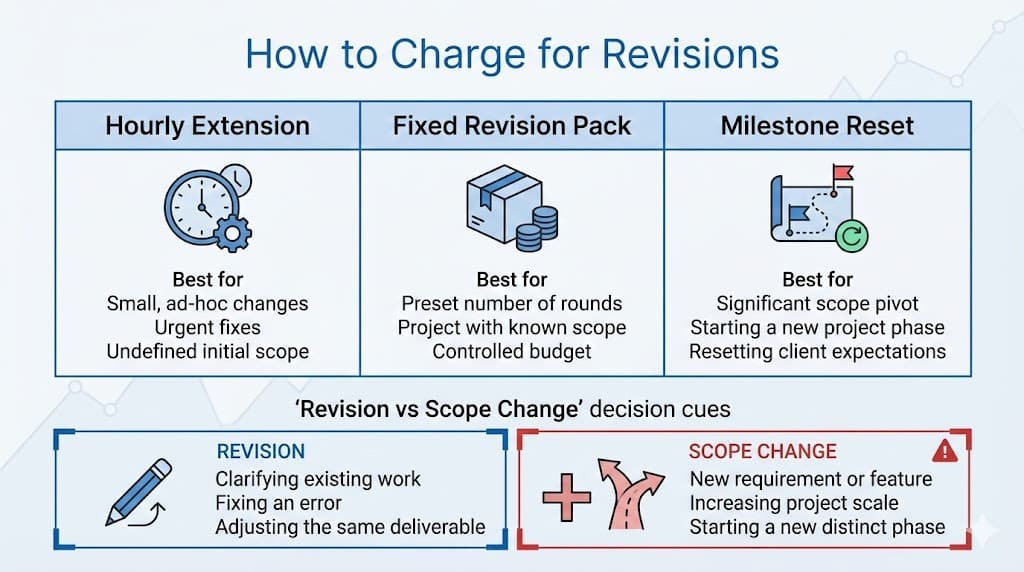
Why this happens
Revision disputes usually start before delivery, not after it. If the contract says includes revisions but does not define round count, turnaround windows, and what constitutes a new request, both parties fill in their own interpretation. Clients assume flexibility. Teams assume containment. The conflict appears when the third or fourth cycle arrives and nobody agrees on whether it is still in scope.
Agency benchmark reports consistently show over-budget delivery and overservicing patterns that map to weak scope controls and unclear revision boundaries (Teamwork.com State of Agency Operations 2023). With already-tight agency margins (Promethean Research Digital Agency Industry Report), even a few unpriced rounds can erase project profit.
The fix is operational clarity: define what a round means, define what triggers extra charges, and make pricing response time predictable so clients can approve quickly.
of agencies cite inaccurate project estimating as a top driver of margin decline.
Source: SoDA & Productive — Talent, Culture & Operations Study (2022) →Practical framework: revision policy that holds
A strong revision policy has five parts: included rounds, scope boundary, response window, pricing method, and approval rule. Use this baseline language and tune numbers for your delivery model:
- Included rounds: This scope includes two revision rounds per deliverable milestone.
- Revision definition: Revisions refine approved direction and do not introduce new features or deliverables.
- Client feedback window: Feedback is due within five business days to maintain timeline.
- Extra revision pricing: Additional rounds are billed at [rate] or [fixed revision pack].
- Approval before work: Out-of-scope revision work starts after written approval.
This mirrors standard service agreement logic where additional services are separated from core scope and require explicit authorization (AIGA Standard Form of Agreement for Design Services).
| Request type | Counts as revision | Counts as scope change |
|---|---|---|
| Copy/visual refinements in approved concept | Yes | No |
| New page, new module, or new campaign asset | No | Yes |
| Rework due to new stakeholder direction | No | Yes |
| Accessibility bug fix against agreed standard | Yes | No |
Common mistakes
- Using unlimited revisions to win deals. It usually transfers risk to your team and turns delivery into a negotiation loop.
- No cutoff for consolidated feedback. Multiple stakeholder streams create parallel revision cycles.
- No response SLA. Client delays in feedback should be tied to timeline impact in writing.
- Pricing revisions after work starts. Quote first, execute second. Reverse order weakens enforceability.
- Ignoring small extras. A few quick updates can become your biggest untracked margin leak.
The strongest policy is the one your team can apply consistently under pressure. Keep definitions simple, keep thresholds explicit, and keep every exception documented.
How Clariva fits
Clariva helps agencies reduce revision conflict upstream by tightening discovery inputs and scope definitions before kickoff. You can then apply a clearer revision policy with fewer ambiguous edge cases.
For script language, use the out-of-scope script guide. For change documentation, use the website change request template. For prevention strategy, read the fixed-price scope creep pillar.
Pricing examples for extra revisions
Revision policy works best when pricing is precomputed, not improvised. Below are practical patterns agencies can apply with minimal math during live delivery.
Example A: fixed revision pack
Scope includes two rounds. Client requests a third round on homepage and two product pages. You predefine an extra-round pack at a fixed price covering consolidated feedback and one turnaround cycle. Client gets cost certainty; team gets bounded effort. This works well in design-heavy work where change size is usually moderate.
Example B: hourly extension with cap
Client asks for ongoing refinements after included rounds. Quote hourly with a not-to-exceed cap and milestone checkpoint. If client wants more after cap, issue a second approval. This prevents silent overspend and gives a clean stop point for decision-making.
Example C: scope reset after direction change
Client introduces a new strategic direction after visual approval. Treat this as rework, not revision. Reprice remaining effort, update milestones, and require new approval. Attempting to treat direction reset as routine revision is one of the fastest ways to convert a profitable project into break-even delivery.
These patterns keep decisions fast because clients see explicit options instead of abstract resistance. The conversation shifts from Should we charge to Which option do you want to approve.
Contract clause pack you can use
Use short, enforceable clauses. Avoid dense legal copy in operational sections. Agencies need language that project leads can reference live on calls without interpretation risk.
- Included rounds clause: This scope includes two revision rounds per milestone.
- Consolidated feedback clause: Feedback must be delivered as one consolidated client response.
- Window clause: Feedback received after five business days may shift milestone dates.
- Additional rounds clause: Additional revision rounds are billable and require written approval.
- Direction change clause: Changes that alter approved direction are treated as scope change requests.
These clauses align to standard service-agreement separation between contracted services and additional services. The key is clarity, not complexity. If the clause cannot be explained in one sentence, simplify it.
Also add a project operations appendix with decision owners and escalation thresholds. Contract clauses define rights; operating notes define behavior. You need both for consistent enforcement across multiple project leads.
Implementation checklist for your team
- Create one revision policy card for each project type: web design, branding, and strategy work.
- Store reusable quote snippets so leads can respond in under 10 minutes.
- Require that every extra-round approval includes cost and timeline impact in the same message.
- Track accepted extra rounds by project and review monthly for pricing calibration.
- Train new account leads using real examples of revision vs scope-change decisions.
Most revision leakage is operational drift. A written policy alone does not prevent it unless teams can use it quickly under pressure. Short templates, clear thresholds, and recurring review are what make policy real.
Communication patterns that reduce revision conflict
Revision policy can be commercially correct and still fail if the communication style is abrupt. Use neutral, process-first language: here is what is included, here is what changed, here are your options. Avoid personal framing such as we cannot keep doing this or this is unreasonable. Clients usually respond better when the message is presented as an agreed process decision rather than a relationship boundary.
A reliable pattern is to present two executable choices every time: one option that preserves current scope and timeline, and one option that expands scope with defined cost and date impact. Decision quality improves when tradeoffs are concrete. Project momentum also improves because the client can approve immediately without requesting additional clarification loops.
Teams that adopt this pattern usually report fewer escalation calls, fewer unpaid just-this-once rounds, and cleaner project closeout. The policy is the structure; communication is the delivery mechanism that makes the structure usable in real projects.
If you need one standard line for difficult moments, use this: We can absolutely support that request. It is outside included revision rounds, so we will send pricing and timeline options for approval.
Monthly revision policy review ritual
Once per month, review three metrics across active projects: number of extra revision approvals, average extra revision value, and unapproved extra effort accepted by teams. You do not need perfect finance data to start. Even directional numbers show where policy is slipping.
If unapproved effort is rising, your issue is usually not contract language. It is response speed. Teams accept extras when quote turnaround is slow. Improve speed with prebuilt pricing options and delegated thresholds. If approved revisions are high but profitable, policy is working. If approvals are high and margin still drops, your pricing packs are likely underestimating effort.
See which scope dimensions are undefined before you commit to a fixed price. Fewer unclear boundaries means fewer revision disputes.
Analyze your briefFrequently asked questions
How many revision rounds should be included in a contract?
Most agencies include one to three rounds depending on project type. The key is not the number itself, but clear definition of what a round includes.
What is a fair extra revisions charge?
Use the same pricing logic as scoped work: hourly, fixed revision block, or milestone extension. It should reflect effort and timeline impact.
Can revision or scope policies hurt client relationships?
Clear policies usually improve relationships because they reduce surprise. Conflict usually comes from undefined rules, not explicit ones.
When should a request be treated as a change request instead of a revision?
If it changes deliverables, effort, timeline, or dependencies, it is a scope change. Revisions refine an agreed deliverable.