How to Prevent Scope Creep: The Agency Playbook
Scope creep is almost never the result of a client acting in bad faith. It is almost always the result of a brief that left something undefined, and two parties who filled the gap with different assumptions. By the time the scope creep surfaces, the brief is signed, the project is underway, and the conversation is more expensive than it should have been.
Why scope creep starts before the first line of code
Scope creep is a discovery failure, not an execution failure. The gap that causes it exists in the brief, not in the build. By the time it surfaces, usually when a client asks for something the agency did not price, the misalignment has been present since the project began. Both parties were working toward different definitions of 'done'.
This is why responding to scope creep with better project management misses the cause. You can track tasks in Linear with perfect fidelity and still deliver a project that the client considers incomplete. The tracking is not the problem. The brief that the tracking is based on is the problem.
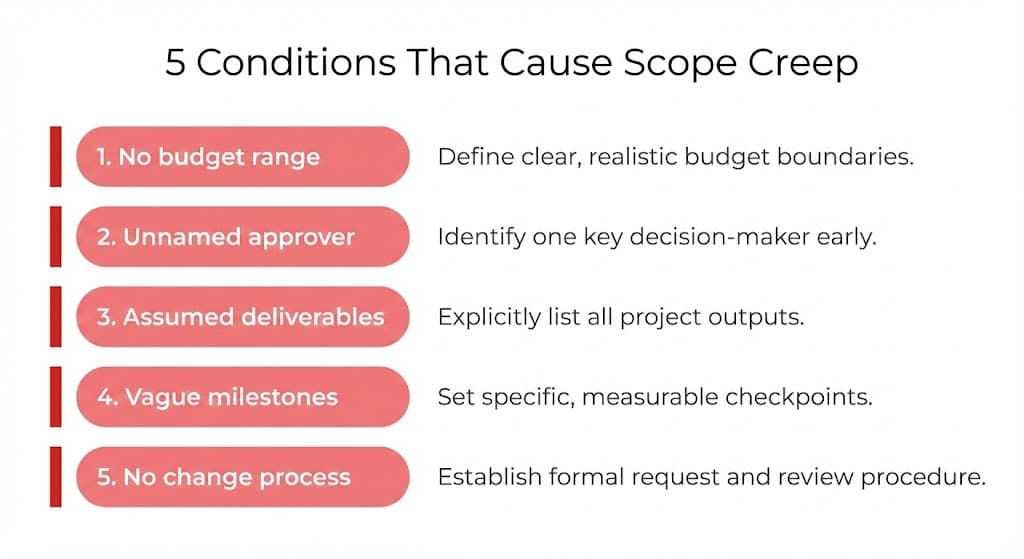
Preventing scope creep means closing the gaps in the brief before commitment, not managing the consequences of those gaps after the project starts. The five conditions below account for the majority of scope creep in agency projects. Each one is preventable at the discovery stage.
of agency leaders say projects at least sometimes come in over budget.
Source: Teamwork.com, State of Agency Operations 2023 (survey of 512 agency leaders) →The 5 conditions that cause scope creep
of agencies report frequent overservicing, and 37% of those cite poor scope-creep handling as the primary reason.
Source: Teamwork.com, State of Agency Operations 2023 (survey of 512 agency leaders) →| Condition | What goes wrong | Brief-level fix |
|---|---|---|
| No budget range | Scope expands to fill ambiguity | Require budget range on intake form |
| Unnamed approver | Revision cycles don't end | Name the final approver, not just their role |
| Assumed deliverables | Client expects more than was priced | List every deliverable with explicit exclusions |
| Vague milestones | No accountability for dependencies | Build timeline backward with named dates |
| No change process | Every request becomes a goodwill decision | Include written change request section in scope doc |
When the budget is undefined or described as 'flexible,' scope expands to fill the ambiguity. The client adds requests because they do not know what their money covers. The agency accommodates them because the budget conversation was never had. A defined budget range, even an approximate one, creates a shared constraint that makes scope conversations possible before they become disputes.
When the person who can actually stop a revision is not named in the brief, revision cycles do not end and they escalate. The project manager approves. Then someone above the project manager sees it and has notes. Then someone above them. Each layer adds a round of revisions that was not in the scope. Name the final approver, confirm their authority, and get their sign-off at each major milestone.
When the brief says 'website' without specifying page count, platform, and included features, both parties build a mental model of what that means. The models are different. The agency prices for what they heard. The client expects what they imagined. The gap surfaces when the agency delivers what they scoped and the client asks where the rest of it is. List every deliverable by name, with explicit exclusions.
A launch date without intermediate milestones creates a hidden timeline risk. When the client delivers content three weeks late, there is no documented milestone they committed to. The delay becomes a negotiation about who is responsible for the launch date moving, rather than a straightforward invocation of a written dependency. Milestones with specific dates, written into the brief, make dependencies visible before they become disputes.
Without a defined process for handling scope changes, every out-of-scope request becomes a goodwill decision. The first one is easy to say yes to. By the fourth one, the economics of the project no longer work and the agency is managing a relationship, not a scope. A written change request process with a minimum pricing threshold, an approval step, and a timeline impact statement makes every additional request a business conversation rather than a test of the relationship.
How to close each gap before the project starts
Each condition maps to a specific step in the discovery process:
For missing budget range
Make budget range a required field on your client intake form. If the client leaves it blank, follow up before scheduling a kickoff call. A client who will not commit to a range at the intake stage is a client who will expand scope without constraint during the project. This is a better-to-know-now risk.
For undefined final approver
Add two questions to your intake form: 'Who reviews deliverables?' and 'Who has final approval?' These are different questions. Get a name for each, not a role. Confirm in the brief that final approver sign-off is required before the agency proceeds from each milestone. Get the final approver's email on the distribution list from kickoff.
For assumed deliverables
Every deliverable in the brief should be named, scoped, and qualified. Use the pattern: [Output], [Format], [Platform], [Quantity]. Then add an explicit exclusions section: 'The following are not included in this scope.' List every common assumption that does not apply. If you are building a website, exclude the blog, the e-commerce module, and the languages you are not localizing for.
For vague timeline milestones
Build the timeline from dependencies, not deadlines. Start with the launch date and work backward: when does QA need to be complete? When does development need to start? When does content need to arrive? Each step becomes a milestone with a specific date. Document the dependency explicitly: 'Development start is contingent on design approval by [date].' When a milestone slips, the downstream impact is visible and documented.
For no change request process
Include a change request section in every scope document. The minimum viable version: 'Any changes to scope must be submitted in writing. Changes with an estimated cost above €X require written approval before work proceeds. All approved changes will affect the project timeline.' This is not a bureaucratic imposition. It is a mechanism that makes scope changes possible without burning the relationship.
What to do when scope creep has already started
Even with a complete brief, scope creep occasionally appears: a client request that is clearly outside scope, a deliverable that was ambiguously described, or a stakeholder who was not in the original agreement. When it happens, the goal is to resolve it without damaging the relationship.
The most effective approach is to acknowledge the request clearly, reference the scope document, and offer a path forward:
- Acknowledge: 'We understand you need [request]. Thank you for flagging it.'
- Reference: 'Our current scope covers [what is included]. This request falls outside that scope, specifically [relevant exclusion or missing specification].'
- Offer a path: 'We can accommodate this as a change request. Here is what it would cost and how it would affect the timeline: [estimate]. Let us know how you would like to proceed.'
The key is not to frame the conversation as the client being wrong. They often genuinely believed the request was in scope. The framing is: here is what we agreed to, here is what you are asking for, and here is the path to get there. When there is a written scope document both parties signed, that conversation is much easier to have.
The absence of a written scope document turns the same conversation into a dispute about what was agreed. That is the conversation you are preventing by investing in discovery.
For mid-project scenarios, use these script and template extensions to keep change conversations structured and billable:
Use a direct script when a request is outside scope: How to tell a client something is out of scope →
Set and enforce revision billing rules: How to charge for revisions →
Document each change request before work starts: Website change request template →
Use the fixed-price prevention framework end to end: How to prevent scope creep in fixed price projects →
Build scope protection into every project from day one
The agencies that manage scope consistently are not the ones with the most aggressive contracts. They are the ones with the most complete briefs. A complete brief makes scope visible before commitment. A written change request process makes scope changes manageable when they occur. Together, they remove the ambiguity that scope creep lives in.
Clariva automates the brief completeness check. Paste any brief and Clariva scores it across all relevant dimensions, flags every gap with the specific condition it maps to (including the five above), and generates a brief pack with a scope definition your team can commit to.
Download a free project scope document template: Project scope document template →
Or see the complete client onboarding checklist: Client onboarding checklist →
Paste any brief. Clariva scores it across all relevant dimensions, flags every scope risk, and generates a brief pack ready for commitment.
Analyze your next brief. Clariva flags all 5 conditions automaticallyFrequently asked questions
What is scope creep?
Scope creep is the gradual expansion of a project beyond what was originally agreed, usually through out-of-scope requests that the agency accommodates without invoicing, or through deliverables that were assumed rather than explicitly defined. It is almost never the result of bad faith. It is almost always the result of a brief that left something undefined, and two parties who filled the gap with different assumptions.
What causes scope creep in agency projects?
Scope creep is caused by five specific conditions in the project brief: no budget range, an unnamed final approver, assumed deliverables, vague timeline milestones, and no change request process. Each one creates ambiguity that the client and agency fill with different assumptions. When those assumptions diverge, scope creep appears, usually when the client asks for something the agency did not price.
How do you handle scope creep when it has already started?
When scope creep has started, acknowledge the request clearly, reference the scope document, and offer a specific path forward. The framing is: here is what we agreed to, here is what you are asking for, here is the cost and timeline impact. The goal is not to make the client feel wrong. They often genuinely believed the request was in scope. A written scope document makes this conversation straightforward. Without one, it becomes a dispute about what was said in a call.
What is a change request process?
A change request process is a written mechanism for handling out-of-scope requests. The minimum viable version requires written submission of the request, a cost and timeline impact estimate, and written approval before work proceeds. It protects both parties: the agency can invoice for additional work, and the client has visibility into what scope changes cost before they happen. Without it, every out-of-scope request is a goodwill decision that compounds across the project.