How to tell a client something is out of scope
Most client scope conflict is not about bad intent. It is about timing. The request arrives mid-project, the team is under delivery pressure, and nobody wants to create friction. The fastest path is to say yes. The expensive path is also to say yes. This guide gives you a repeatable script you can use when a client asks for extra work, so you protect margin without damaging trust.
Why this happens
Agency teams usually know when a request is outside scope. The hard part is saying it fast, clearly, and without creating an emotional standoff. Teams delay the message because they want to stay collaborative, then absorb the extra work as just one more thing. That pattern feels small in real time but compounds across fixed-fee projects where every unpriced hour directly compresses margin.
of agencies cite scope creep as a driver of margin decline — and 20% cite better scope creep management as a driver of margin gains.
Source: SoDA & Productive — Talent, Culture & Operations Study (2022) →Benchmark data shows this is structural, not a one-off client personality problem. A large share of agency leaders report projects running over budget and overservicing patterns tied to weak scope boundaries (Teamwork.com State of Agency Operations 2023). Margin pressure is already tight in digital agency operations, so repeated out-of-scope work is usually paid by the agency, not recovered later (Promethean Research Digital Agency Industry Report).
The practical implication: your scope response needs to be pre-written, contract-aligned, and easy for any account lead to use. If the script depends on confidence or improvisation, it will fail under deadline pressure.
Practical framework: what to say and when
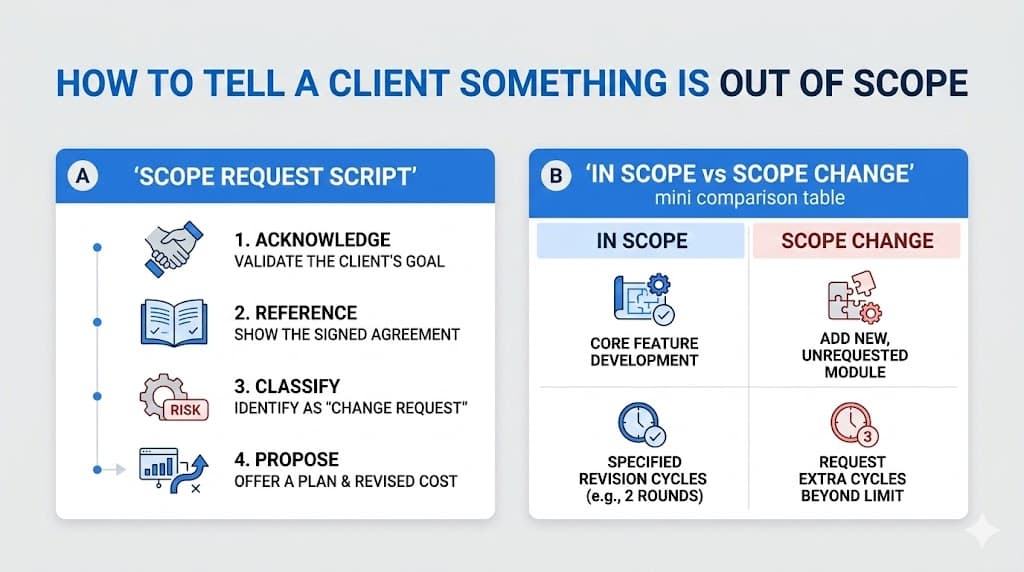
Use this four-step sequence whenever a client asks for extra work: acknowledge, reference, classify, and propose. It keeps the tone collaborative while keeping the boundary operational.
- Acknowledge: Thanks for raising this. It makes sense for the outcome you want.
- Reference: In our signed scope, we included X and excluded Y.
- Classify: This request is a scope change, not an in-scope revision.
- Propose: We can deliver it under a change request with cost and timeline options below.
That sequence aligns with common design-service agreement structure where scope boundaries and additional services are explicitly documented (AIGA Standard Form of Agreement for Design Services). You are not rejecting the client request. You are routing it through the agreed mechanism.
| Decision point | In-scope revision | Scope change |
|---|---|---|
| Deliverable | Same deliverable, refinement only | New deliverable or feature |
| Effort | Within included hours/rounds | Adds net-new production effort |
| Timeline | No milestone shift | Requires rescheduling or rush work |
| Commercial treatment | Covered by agreement | Change request quote + approval |
Common mistakes
- Answering on live calls without documents open. Scope decisions should reference written terms in real time.
- Using defensive language. That is not our fault escalates conflict. Here is the agreed scope and path keeps control.
- Delaying classification. If you complete work first and classify later, you teach clients that scope is flexible by default.
- No written follow-up. Every out-of-scope conversation should end with a recap email and explicit next step.
- No threshold rule. Teams need a clear always quote threshold so account leads are not making ad hoc pricing decisions.
The strongest teams operationalize this with templates and routing rules: standard client response scripts, a change request form, and a review checkpoint before work is accepted. That is how you prevent friendly exceptions from becoming a pricing model.
How Clariva fits
Clariva helps before this conversation happens. It scores discovery completeness, flags missing scope terms, and identifies where unclear deliverables or approval structures are likely to produce mid-project change pressure. You can use that signal before kickoff, then use the script above when live requests appear.
If you want the full fixed-price prevention layer, use this fixed-price scope creep guide. For revision boundaries, use this revision pricing guide. For documentation, use the website change request template.
Script library: email, call, and follow-up formats
Teams often ask for one perfect line to use when a client asks for extra work. In practice, you need a sequence, because scope conversations happen across channels. The safest pattern is live acknowledgement, written classification, then documented decision. This avoids emotional debate in meetings and creates evidence if memory diverges later.
Live call response (30-second version)
Use this when a new request appears on a status call: Thanks for raising that. Based on the scope we approved, this looks like additional work rather than an included revision. We can absolutely support it. We will send a short change note with cost and timeline impact today so you can decide quickly.
Email follow-up (classification format)
Subject: Scope change request summary. Body: Requested change, scope reference, effort impact, timeline impact, and decision options. Keep this to five bullets. Long explanations make approval slower. The goal is not persuasion; the goal is decision clarity.
Decision reminder (when client is silent)
If no decision arrives within your SLA window, send one neutral reminder: We can proceed with Option A and hold current timeline, or approve Option B and move milestone X by Y days. If no confirmation arrives by [date], we will continue under current scope baseline to protect launch timing.
This structure prevents teams from drifting into implied approvals. It also helps clients because tradeoffs are explicit: keep timeline, or expand scope with known impact. Hidden tradeoffs are where conflict starts.
Operating playbook for account leads
Scripts only work if team behavior supports them. Use these operational rules at project level so out-of-scope decisions are consistent across account leads:
- Single owner for scope decisions: one named lead classifies requests before delivery work begins.
- 24-hour response SLA: every scope change gets written impact within one business day.
- No verbal approvals: all changes require email confirmation from authorized client approver.
- Weekly scope review: review open changes, aging requests, and accepted extras every week.
- Threshold escalation: high-impact changes route to agency leadership automatically.
These rules reduce variance. Without them, one lead may absorb changes to preserve relationship while another enforces scope aggressively. Inconsistent behavior is costly because clients compare treatment across projects. Consistency builds trust faster than leniency.
A practical implementation sequence is simple: train on the decision table, publish script templates in your project workspace, and audit two live projects weekly for request classification quality. Teams improve quickly when they see concrete examples of accepted vs repriced requests.
If a lead is unsure, classify conservatively and escalate. Wrongly treating a scope change as in-scope creates direct financial loss. Wrongly escalating for review creates a short delay. In fixed-fee delivery, conservative classification is usually the lower-risk error.
Finally, make scope language visible to clients early and often. Include a short boundary reminder in kickoff notes, milestone recaps, and review agendas. Repetition reduces surprise, and lower surprise usually means faster approvals when extra work is requested.
Real-world scope response sequence
Day 1: request appears. Day 1: classify and acknowledge. Day 1: send short impact note. Day 2: confirm decision and either proceed under baseline or approved change. This sequence sounds basic, but teams skip it most often when delivery is busy. The cost of skipping is hidden until late project stages.
If you are training new leads, run role-play sessions with actual historical requests. Practice the exact phrasing for acknowledge, reference, classify, and propose. Teams build confidence quickly when language is rehearsed. Confidence matters because unclear wording is the main reason leads overexplain, and overexplaining usually weakens boundary clarity.
Keep one short policy for exceptions: if extra work is intentionally gifted, record it as a discretionary goodwill exception with owner approval and estimated effort. This prevents accidental normalization of free work and gives leadership visibility into where relationship strategy is being used.
Clear scope before kickoff means fewer out-of-scope conversations mid-project. See where your current brief leaves gaps.
Analyze your briefFrequently asked questions
How do you politely tell a client something is out of scope?
Acknowledge the request, reference the agreed scope, and present options with cost and timeline impact. Keep the tone neutral and operational.
Should I say yes to small extra requests to keep the relationship healthy?
You can make discretionary exceptions, but document them and set a boundary. Repeated unpriced extras usually erode margin and expectations.
What if the client insists the request was implied?
Treat it as an ambiguity event. Show what was written, state what is missing, and propose a fast change request path so the project keeps moving.
When should a request be treated as a change request instead of a revision?
If it changes deliverables, effort, timeline, or dependencies, it is a scope change. Revisions refine an agreed deliverable.