of agency leaders say projects at least sometimes come in over budget.
Source: Teamwork.com, State of Agency Operations 2023 →of agencies report frequent overservicing, and 37% of those cite poor scope-creep handling as the primary reason.
Source: Teamwork.com, State of Agency Operations 2023 →of US agencies lose $1,000–$5,000 every month to unbilled out-of-scope work. Only 1% successfully bill for all out-of-scope work.
Source: Ignition, 2025 Agency Pricing & Cash Flow Report →Agency Scope Creep: Causes, Cost, and How to Prevent It
Scope creep is the most common reason agency projects go over budget, and it is also the most preventable. It does not begin when the client asks for something new. It begins when the brief leaves something undefined. By the time scope creep surfaces, the misalignment has been present since the project started.
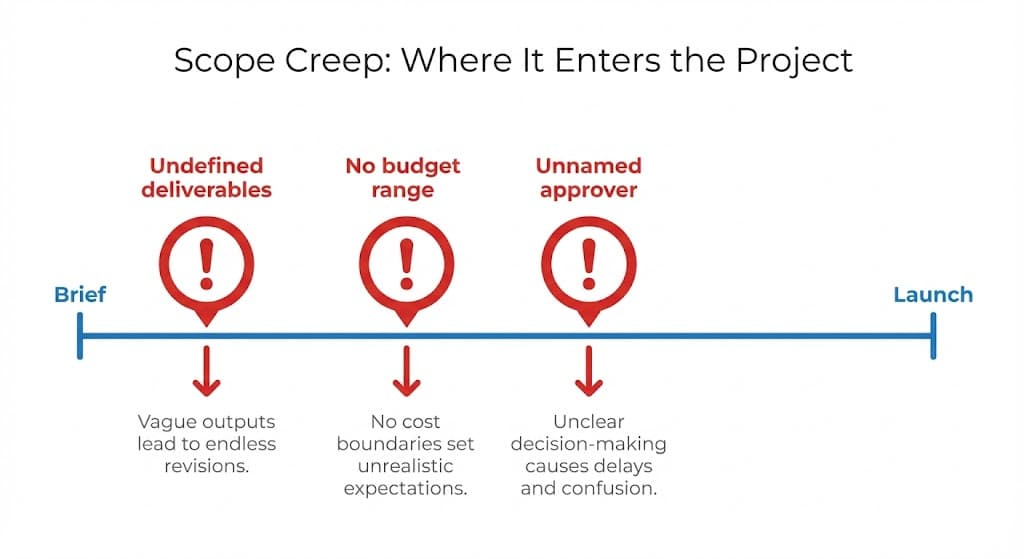
What scope creep actually is
Scope creep is not a client asking for more work. It is a client asking for work they believe was already included, while the agency discovers the brief never made the boundaries explicit enough to prevent that assumption. Both parties are acting in good faith. The problem is the brief.
The distinction matters because it changes where you intervene. If scope creep is a client behavior problem, you respond with better contracts and stricter change request enforcement. If it is a brief quality problem, which it almost always is, you respond at the discovery stage before commitment, where the fix is cheap and the leverage is high.
The five conditions that reliably produce scope creep are: undefined budget range, unnamed final approver, assumed deliverables, vague timeline milestones, and no change request process. Every one of them is a brief gap. Every one of them is preventable at the intake stage.
The financial cost agencies rarely calculate
At an average 15% net margin, a digital agency keeps EUR15,000 from a EUR100,000 project. If scope creep adds 20% more unbilled hours, a conservative estimate for a project with undefined deliverables, those extra hours cost more than the entire profit margin. The client paid the same price. The agency worked more. The economics collapsed.
of unsuccessful projects fail to meet their goals due to poor requirements management, the single leading cause of project failure across all types.
Source: PMI Pulse of the Profession Requirements Management →The financial cost is not limited to direct hours. Scope creep also consumes management capacity: time spent in conversations about what was agreed, revision rounds that extend past their budget, and client relationship management that should not be necessary. These costs compound fast at a 15% average net margin, where a single overrun can eliminate the profit from multiple other projects.
The five conditions and how to close them
Each condition maps to a specific gap in the brief. Closing it requires a specific field or question at the intake stage, not a better contract or a tighter revision policy.
Without a committed budget range, scope expands to fill the ambiguity. The client adds requests because they do not know what their money covers. Fix: make budget range a required field on the intake form. If the client leaves it blank, resolve it before scheduling the kickoff call.
When the person who can stop a revision cycle is not named in the brief, revisions do not end and they escalate. Fix: ask 'Who reviews deliverables?' and 'Who has final approval?' as separate questions. Get names, not roles.
A brief that says 'website' without specifying page count, platform, and exclusions leaves the client to fill in the rest with their imagination. Fix: list every deliverable by name with explicit exclusions. If you are not building the blog, write that down.
A launch date with no intermediate milestones means the client has no committed delivery dates for content, feedback, or approvals. Fix: build the timeline backward from the launch date, documenting each dependency with a specific date and owner.
Without a written process for handling out-of-scope requests, every addition becomes a goodwill decision. By the fourth one, the project is underwater. Fix: include a change request section in every scope document. Minimum viable version: written submission, approval step, timeline impact statement.
When scope creep has already started
Even with a complete brief, scope disputes occasionally emerge. The most effective resolution approach keeps the relationship intact: acknowledge the request, reference the scope document, and offer a concrete path forward. The key is not framing the client as wrong. They often genuinely believed the request was included. The framing is: here is what we agreed to, here is what you are asking for, and here is how we get there.
When there is a written scope document both parties signed, that conversation is straightforward. When there is not, it becomes a dispute about what was said in a call three months ago. The brief is not just a planning tool. It is the enforcement mechanism that makes scope protection possible without damaging the relationship.
Related resources
Analyze your brief for scope risk before you commit.
Clariva scores completeness, flags every gap with the specific risk it creates, and generates a scope document your team can commit to. It works as a practical scope creep prevention tool for agency teams.