Client Onboarding for Agencies: The Process That Prevents Churn Before Work Starts
The first two weeks of an agency engagement set the pattern for everything that follows. When clients and agencies align on process, communication, and scope in week one, that alignment tends to hold. When they do not, the gap compounds, and most of what gets attributed to project failure traces back to how the engagement started, not how it was executed.
Why onboarding determines project outcomes
Client onboarding is not a formality. It is the stage where both parties commit to a shared understanding of scope, process, and timeline. When that commitment is explicit, documented, reviewed, and signed, it holds under pressure. When it is implicit, assumed, verbal, or skipped, it frays at the first sign of ambiguity.
The patterns that cause project failure are almost always present from the beginning. A stakeholder who was not in the kickoff. A content delivery date that was assumed, not confirmed. An approval process that everyone thought they understood but no one had written down. These conditions originate in onboarding, not execution. Fixing them at the execution stage is expensive. Preventing them at the onboarding stage is fast and cheap.
Structured onboarding is the highest-leverage investment in the client lifecycle, not because it improves the relationship, but because it removes the ambiguity that causes relationships to deteriorate.
The 57% who cut onboarding investment and saw churn
The connection between onboarding quality and client retention is not theoretical. When companies reduce their investment in structured onboarding, whether by shortening the process, removing documentation steps, or relying on informal coordination, churn follows within months.
of companies that cut onboarding investment saw measurable churn within 6 months, showing a direct cause-and-effect relationship.
Source: OnRamp, 2026 State of Customer Onboarding (161 B2B leaders) →For agencies, the onboarding-to-retention link operates through a specific mechanism: clients who are not aligned on scope and process early are the clients who raise disputes later. The dispute itself is rarely about the work. It is about what was expected versus what was delivered, which is an onboarding gap, not a quality gap.
of people say they would be more likely to stay loyal to a business that invests in onboarding content that welcomes and educates them after purchase.
Source: Wyzowl, Customer Onboarding Statistics 2020 (survey of 216 people) →The agencies with the highest client retention rates are not necessarily the ones producing the best work, though they often are. They are the agencies that eliminate ambiguity early enough that clients never develop the misalignment that causes them to leave.
74% are still running onboarding manually
Despite the evidence on retention impact, most agencies, and most B2B service businesses, still handle client onboarding through a combination of emails, spreadsheets, and project management tools that were not designed for it.
of B2B companies are still running onboarding manually, via spreadsheets, emails, and project management tools not designed for it.
Source: OnRamp, 2026 State of Customer Onboarding →Manual onboarding has a predictable failure mode: it is inconsistent. Different project managers run it differently. Different clients receive different levels of documentation. There is no standard for what 'complete onboarding' looks like, which means there is no reliable way to know whether a project is actually ready to start.
The inconsistency compounds at scale. As an agency grows, manual onboarding becomes a bottleneck, and the gaps it leaves become more expensive to resolve. The agencies that digitize and standardize their onboarding process see measurable improvements in time-to-value and client satisfaction, because both parties are working from the same documented foundation.
reduction in time-to-value for teams that digitized their onboarding process, versus manual coordination.
Source: OnRamp, 2026 State of Customer Onboarding →What structured client onboarding looks like
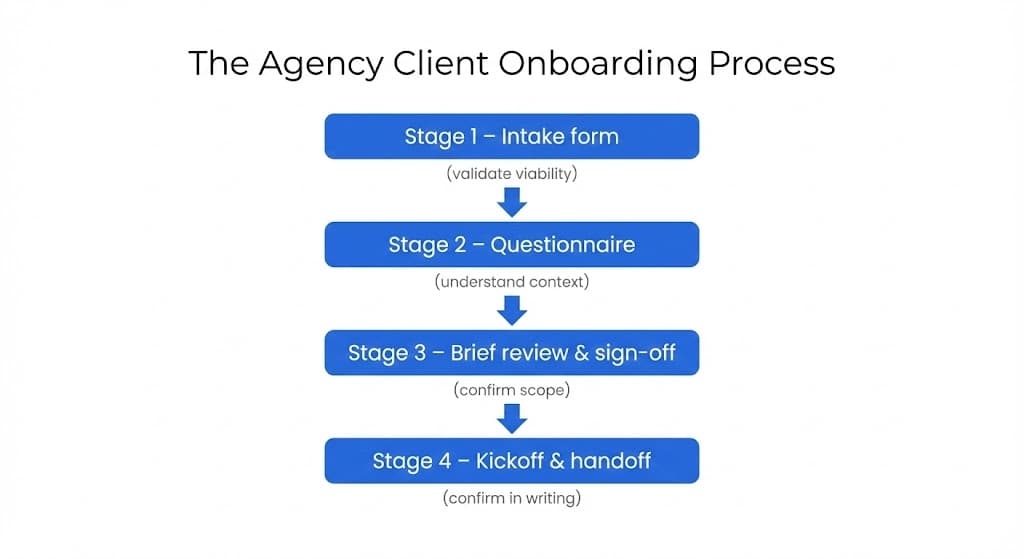
A structured agency onboarding process has four stages. Each stage has a specific output that must exist before the next stage begins.
Stage 1: Intake
Before the first call, send a client intake form that captures the minimum information needed to validate the project: budget range, timeline, deliverables, key stakeholders, technical constraints, and content ownership. The intake answers the question: is this project viable to commit to? If the intake comes back incomplete, with no budget, no approval chain, or vague deliverables, those gaps become the first agenda items on the kickoff call.
Stage 2: Questionnaire
After the intake confirms viability, a questionnaire goes deeper: brand context, past agency experience, competitive landscape, decision-making culture. This is where you collect the context needed to do the work well, not just to scope it. The questionnaire is sent after the intake is complete, so you are not asking understanding questions before you have confirmed the project is scoped and budgeted.
Stage 3: Brief review and sign-off
With intake and questionnaire complete, you have enough to write a project brief. Review it against a completeness standard: are all coverage dimensions present and specific? Is the final approver a name, not a role? Are deliverables named with explicit exclusions? Every gap at this stage is a risk flag to resolve before commitment. Get sign-off from both parties on the brief as written.
Stage 4: Kickoff and handoff
The kickoff call, with a completed brief and a signed scope document, becomes a confirmation meeting rather than a discovery session. You are confirming what both parties already agreed to in writing: milestones, communication cadence, revision process, escalation path. The kickoff notes, sent within 24 hours, document what was confirmed. From this point, the project is running on a shared, documented foundation.
The intake form as the first onboarding step
The intake form is the first structured touchpoint of the onboarding process, and the highest-leverage one. It sets the tone for the engagement: the agency is organized, asks specific questions, and requires specific answers before committing. Clients who fill out a well-structured intake form begin the project with a clearer understanding of what they are signing up for.
of enterprise organisations rate their onboarding approach as a key driver of client value, reinforcing that structured onboarding is a strategic investment, not a formality. (Figure applies to enterprise segment specifically.)
Source: Precursive, Customer Onboarding Benchmark Report 2021 →The intake form also creates the first evidence of accountability. When budget, timeline, and deliverables are documented before the project starts, both parties have a written record of what was agreed. This makes scope disputes significantly easier to resolve, because the resolution is a reference to the document, not a dispute about what was said in a call.
of customer success leaders lack real-time visibility into onboarding progress, a systemic blind spot across B2B organizations.
Source: OnRamp, 2026 State of Customer Onboarding (161 leaders) →A structured intake process solves the visibility problem. When every client completes the same intake form, the agency has consistent, comparable data across all projects, making it possible to identify patterns, flag risk earlier, and allocate resources more predictably.
Download a free client intake form template to use as your first onboarding step: Client intake form template →
See the full client onboarding checklist for every stage: Client onboarding checklist →
Describe your project in one to three sentences. Clariva generates a structured intake questionnaire and publishes it to a shareable link in under two minutes.
Generate a tailored client intake, Clariva builds it from your project descriptionFrequently asked questions
What is client onboarding for agencies?
Client onboarding for agencies is the structured process that begins when a client commits to a project and ends when work formally starts. It covers intake (validating project viability), questionnaire (collecting context for the work), brief review and sign-off (confirming scope and approval chain), and kickoff. Its purpose is to ensure both parties begin the project from the same documented foundation, with scope, process, timeline, and communication all aligned before a single hour is billed.
What should a client onboarding process include?
A complete agency client onboarding process should include a client intake form capturing budget, timeline, deliverables, and approval chain; a questionnaire for brand context and decision-making culture; a brief review against a completeness standard; and a kickoff call that confirms rather than discovers what both parties agreed to. Each stage has a specific output. Discovery is complete when a signed scope document exists.
How long should agency client onboarding take?
For most projects, structured client onboarding takes between two and five business days from intake to signed scope. The intake and questionnaire can be completed asynchronously by the client, typically in one to two days. Brief review and sign-off takes one to two business days. A kickoff call follows. The investment is small relative to the risk it eliminates, because most scope disputes and client churn trace back to gaps in this stage.
What is the difference between client onboarding and a kickoff call?
A kickoff call is one event. Client onboarding is the full process that the kickoff call closes. When onboarding is done correctly, the kickoff call is a confirmation meeting, and you are reviewing what both parties already agreed to in writing, not discovering it. When onboarding is skipped or abbreviated, the kickoff call becomes a discovery session, and the gaps it leaves will surface as disputes, scope changes, or revision cycles during the project.