Agency Client Onboarding Checklist and Process
The first two weeks of an agency engagement set the pattern for everything that follows. When scope, process, and timeline are aligned in week one, that alignment holds. When they are not, the gap compounds, and most of what gets attributed to project failure traces back to how the engagement started.
What client onboarding actually is
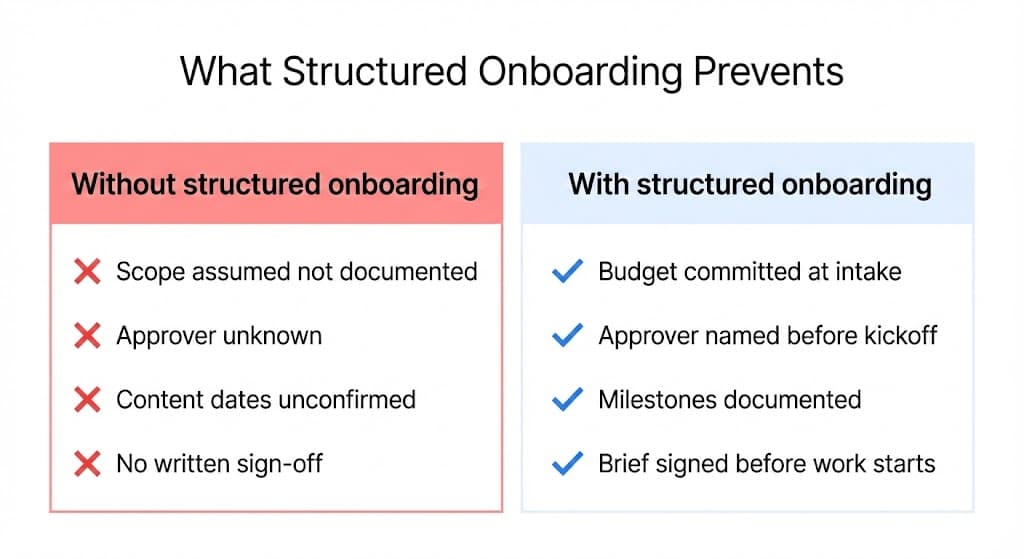
Client onboarding is not a welcome email and a kickoff call. It is the stage where both parties commit to a shared understanding of scope, process, timeline, and communication in writing. When that commitment is explicit, documented, and signed, it holds under pressure. When it is informal, assumed, or skipped, it frays at the first sign of ambiguity.
The patterns that cause project failure are almost always present from the beginning: a stakeholder who was not in the kickoff, a content delivery date that was assumed rather than confirmed, an approval process that everyone thought they understood but no one had written down. These originate in onboarding, not execution. Fixing them after the project starts is expensive. Preventing them before it starts is fast.
Why 74% still get this wrong
Most agencies run onboarding through a combination of emails, spreadsheets, and project management tools that were not designed for it. The process is different for every project manager. Clients receive different levels of documentation depending on who handles the project. There is no standard for what complete onboarding looks like.
reduction in time-to-value for teams that digitized their onboarding process, versus manual coordination via email and spreadsheets.
Source: OnRamp, 2026 State of Customer Onboarding →Manual inconsistency compounds at scale. As an agency grows, the gaps left by informal onboarding become more expensive to resolve, and the clients who churn are often the ones who never fully understood what they signed up for. Standardizing onboarding is not about adding bureaucracy. It is about ensuring every client starts from the same documented foundation.
The 4-stage client onboarding process
A structured agency onboarding process has four stages. Each has a specific output. Each must be complete before the next begins.
Before the first call, send a client intake form that captures the minimum information needed to validate the project: budget range, timeline, deliverables, key stakeholders, technical constraints, and content ownership. The intake answers one question: is this project viable to commit to? If the budget is blank or the approval chain is undefined, those gaps become the first agenda items on the kickoff call, not surprises discovered in week three.
After the intake confirms viability, a questionnaire goes deeper: brand context, past agency experience, competitive landscape, decision-making culture. This is where you collect the context needed to do the work well, not just to scope it. The questionnaire is sent after the intake is complete, so you are never asking understanding questions before you have confirmed the project is scoped and budgeted.
With intake and questionnaire complete, write a project brief and review it against a completeness standard. Every coverage dimension present and specific. Final approver named, not just their role. Deliverables named with explicit exclusions. Every gap at this stage is a risk flag to resolve before commitment. Get sign-off from both parties on the brief as written. That sign-off is the enforcement mechanism.
With a completed brief and signed scope document, the kickoff call becomes a confirmation meeting. You are confirming what both parties already agreed to in writing: milestones, communication cadence, revision process, escalation path. Kickoff notes go out within 24 hours. The project is now running on a shared, documented foundation, not a shared memory of what was said.
The intake form as the first onboarding step
The intake form is the first structured touchpoint of the onboarding process and the highest-leverage one. A well-structured intake form tells the client that the agency is organized, asks specific questions, and requires specific answers before committing. Clients who complete it begin the project with a clearer understanding of what they are signing up for. That clarity is the foundation of retention.
of enterprise organisations rate their onboarding approach as a key driver of client value, reinforcing that structured onboarding is a strategic priority, not a formality. (Figure applies to enterprise segment specifically.)
Source: Precursive, Customer Onboarding Benchmark Report 2021 →The intake also creates the first record of accountability. When budget, timeline, and deliverables are documented before the project starts, both parties have a written record of what was agreed. Scope disputes, when they occur, resolve against a document rather than against competing memories of a call.
Related resources
FAQ
What is an agency client onboarding checklist?
It is a documented pre-kickoff, kickoff, and handoff checklist that confirms scope, stakeholders, approvals, and milestones before delivery starts.
How long should agency onboarding take?
Most agencies complete onboarding in one to two weeks, depending on stakeholder availability and scope complexity.
What should be included in onboarding?
At minimum: intake completeness, budget/timeline clarity, named final approver, scope/exclusions review, milestone plan, and communication cadence.
Generate a tailored intake form in under two minutes.
Describe your project. Clariva generates a structured questionnaire and publishes it to a shareable link, ready to send to your client.