lost annually by US businesses due to poor communication, equivalent to $12,506 per employee per year
Source: Grammarly & Harris Poll, State of Business Communication 2022 →of people say they have personally wasted time as a result of communication issues in their business
Source: Project.co, Business Communication Statistics 2026 →average hours lost per week per employee due to poor communication, based on an estimated 7.47 hours of lost productivity
Source: Grammarly & Harris Poll, State of Business Communication 2022 →Project Communication Failures: Cost, Causes, and How Briefs Prevent Them
Most project communication failures are not communication problems. They are brief problems that manifest as communication failures. When the scope was never specific, the revision request looks like a client changing their mind. When the approval chain was never documented, the stakeholder who appeared in week eight looks like an ambush. The communication broke down because the brief was incomplete from the start.
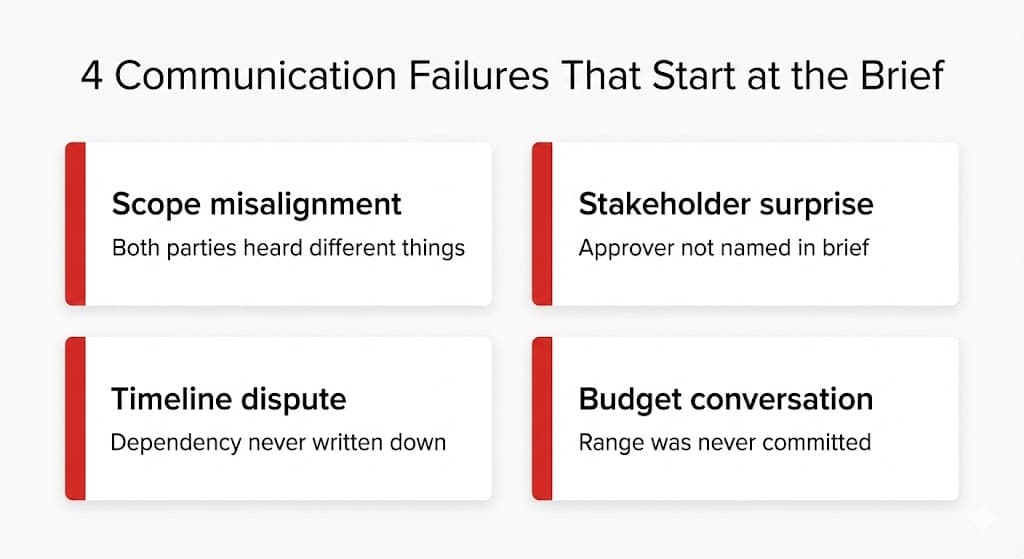
The communication failure taxonomy
Project communication failures cluster around four patterns. Each looks like a communication issue at the surface. Each is a brief gap underneath.
The client believes certain work is included. The agency believes it is not. Both are communicating accurately, but they agreed to different things because the brief never specified. What looks like a miscommunication is a missing deliverable definition.
A decision-maker who was not in the project appears with significant feedback. This is almost always an approval chain problem: the brief named a contact, not a final approver, and the contact never had authority to end a revision cycle.
The project is late, but both parties believe the other is responsible. The agency assumed content would arrive by a certain date. The client never committed to that date in writing. The dependency was never documented, so accountability is absent.
The agency invoices for out-of-scope work. The client disputes it. The conversation that follows is harder than the one that should have happened during discovery, when the budget range and change request process should have been established.
The cost beyond the invoice
The financial cost of poor communication is significant at the macro level, but the operational cost at the project level is what agencies feel directly. Nearly eight hours per employee per week lost to communication failures is not a figure most agencies would recognize as lost time, because the hours are distributed across dozens of small interactions: clarifying emails, re-explaining decisions, and managing expectations that should have been set in writing before the project started.
The retention impact is equally direct. Clients who experience communication failures do not necessarily complain about the quality of work. They describe feeling confused, uninformed, or misaligned. They leave because the experience of working with the agency was unclear, not because the deliverables were poor.
of customers who switched to a competitor did so because of inadequate communication, not inadequate product or service quality.
Source: Project.co, Business Communication Statistics 2026 →How structured intake prevents communication failure
A structured intake form does not improve communication by making people better communicators. It prevents the specific gaps that produce miscommunication by forcing both parties to commit to specifics before the project starts.
When the budget range is committed in writing at intake, the budget conversation does not happen mid-project. When the final approver is named before the kickoff call, the approval chain does not surface as a surprise at the final presentation. When content delivery dates are documented at the brief stage, timeline disputes have a written resolution mechanism rather than a memory dispute.
The intake form is not a communication tool. It is a pre-commitment clarity tool. It transforms the assumptions that produce communication failures into documented agreements that prevent them. The quality of communication throughout the project improves not because the intake changed how people talk, but because it removed the gaps that produce misalignment in the first place.
Download the client questionnaire template to collect what you need before the first call →The communication standard every agency should set
The agencies with the lowest rates of communication failure share a common standard: no project starts without a written record of what both parties agreed to. Not a verbal agreement from a kickoff call. Not an email thread that references a conversation. A structured document that covers scope, budget, timeline, approval chain, and content ownership, signed before a single hour is billed.
This standard does not require extensive process overhead. A structured intake form, a completeness review, and a brief sign-off add two to four hours to the pre-commitment stage. Those hours prevent the ten to twenty hours of communication management that unstructured projects typically require, and protect the client relationship that makes retention possible.
Related resources
Generate a structured intake in under two minutes.
Describe your project. Clariva generates a section-organized questionnaire and publishes it to a shareable link, ready to send to your client.